The Liquid Mountain: Tragedy and Transience on the Nepal-Tibet Frontier
For centuries, the high-altitude frontier dividing Nepal and Tibet has been mythologized as a realm of glacial serenity—a silent, vertical kingdom where the earth scrapes the heavens in frozen permanence. Yet, in recent days, this majestic roof of the world transformed into a kinetic theater of destruction. Swept by unprecedented, torrential rains, the fragile mountain corridors have collapsed in a series of catastrophic landslides and flash floods, leaving hundreds dead, countless missing, and entire settlements erased. It is a stark reminder that in the era of accelerated climate destabilization, the mountains are no longer static monuments; they are fluid, volatile, and increasingly hostile to the human life clinging to their folds.
The devastation has carved through some of the most isolated communities on earth, where the border between Nepal and Chinese-administered Tibet is defined less by geopolitical markers than by the sheer verticality of the terrain. Here, rivers swollen to apocalyptic volumes burst their banks, carrying away concrete homes, ancient suspension bridges, and the terraced farms that represent generations of subsistence. The mudslides did not merely descend; they obliterated, swallowing transit arteries like the Arniko Highway—a vital economic lifeline—and trapping travelers and locals alike in a chokehold of silt and debris. For those living along these precipitous slopes, the disaster arrived not as a sudden anomaly, but as a monstrous amplification of the annual monsoon, rendered furious by a warming atmosphere that holds more water and melts glaciers at a terrifying velocity.
```
"The mountain did not just slide; it liquefied. In a matter of seconds, the landscape we knew was replaced by a roaring grey void."
```
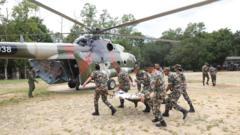
At these altitudes, rescue and recovery operations operate under a law of cruel physics. The very geography that lends this region its sublime beauty now conspires against the survivors. Heavy fog, precarious terrain, and the constant threat of secondary landslides have grounded aerial rescue efforts, leaving local authorities and desperate survivors to dig through tons of wet earth with rudimentary tools and bare hands. This tragedy also underscores a bitter geopolitical irony: while the waters flow indifferently across the highly securitized Nepal-Tibet border, the human response remains fragmented by sovereignty and logistics. The disaster has forced a rare, urgent coordination between Kathmandu and Beijing, yet the sheer scale of the ruin mockingly outpaces the bureaucratic machinery of both nations.
When the floodwaters eventually recede and the silt dries into a hard, gray crust, the Himalayan borderlands will confront a permanently altered reality. This is not a localized tragedy to be archived and forgotten, but a preview of a destabilized future for the Hindu Kush-Himalaya region, which provides water to nearly two billion people downstream. As the global climate engine shifts, the communities on the frontline of this transition are discovering that their ancient relationship with the mountains—once governed by a delicate, respectful equilibrium—has been replaced by a volatile lottery of survival. What remains in the wake of the deluge is a haunting silence, punctuated only by the roar of rivers that have tasted the vulnerability of the heights.