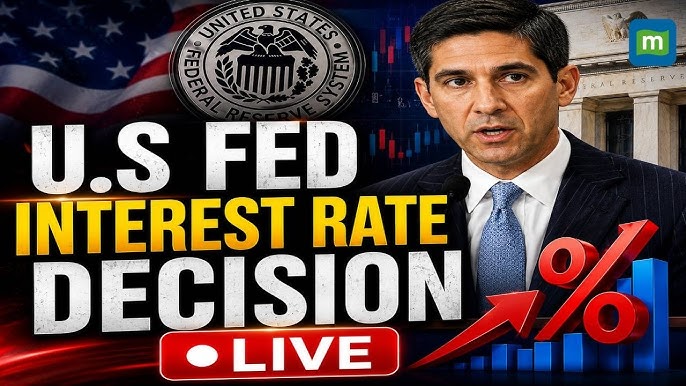
The Technocrats’ Tightrope: Deciphering the Federal Reserve's Latest Decree
Inside the austere, Neo-Classical fortress of the Marriner S. Eccles Building, economic destiny is treated less like a clinical science and more like a high-stakes liturgy. The Federal Reserve’s latest interest rate decision arrived this week not merely as a dry bureaucratic update, but as a decree issued to an anxious republic waiting on the steps of a secular temple. For months, the financial world has held its collective breath, suspended in a state of high-strung anticipation that blends the mathematical rigor of quantitative analysis with the superstitious hope of ancient augury. In choosing its latest course of action—navigating the razor-thin margin between a cooled labor market and the stubborn embers of inflation—the central bank has once again demonstrated that its true currency is not paper money, but psychological management.
At the heart of the Fed's maneuver is a calculated recalibration, a quiet acknowledgment that the aggressive monetary tightening of the past two years must now yield to a more delicate stewardship. By adjusting the levers of borrowing costs, the committee seeks to engineer the mythical "soft landing"—that elusive macroeconomic miracle where inflation is tamed without plunging the nation into the cold dark of recession. Yet, beneath the clinical elegance of the Chairman’s press conference prose lies a harsher reality. For the average consumer, these decimal-point adjustments dictate the visceral boundaries of daily life: the feasibility of a mortgage, the compounding weight of credit card debt, and the nagging, ambient anxiety of a labor market that is slowly losing its post-pandemic fever.
> "We are operating in a zone of asymmetry, where the cost of moving too quickly to ease policy is weighed against the danger of waiting until the engine of growth has already stalled."
Indeed, the cultural weight of the Fed’s policy extends far beyond the trading floors of Lower Manhattan. We live in an era of pecuniary hyper-awareness, where ordinary citizens track basis points with the same obsessive devotion once reserved for sports scores or political polling. This latest decision underscores a profound shift in the collective psyche—a transition from the easy-money optimism of the last decade to a sober, permanent vigilance. The central bank's hesitant choreography reveals an institution acutely aware of its own limitations; it can suppress demand and cool overheating markets, but it cannot repair fractured global supply chains or soothe the geopolitical friction that continues to warp the global economy.
Ultimately, the Fed's announcement is a reminder of the fragile scaffolding upon which the modern economic architecture rests. As the dust settles on this latest cycle of policy calibration, the message from Washington is clear: normalcy is not returning, but is instead being redefined. In this new landscape of elevated rates and persistent uncertainty, the central bank remains our chief secular oracle—imperfect, highly scrutinized, and perpetually tasked with writing the script for an unplannable future.