The White Mirror of Deep Time: What Lake Bonneville Left Behind
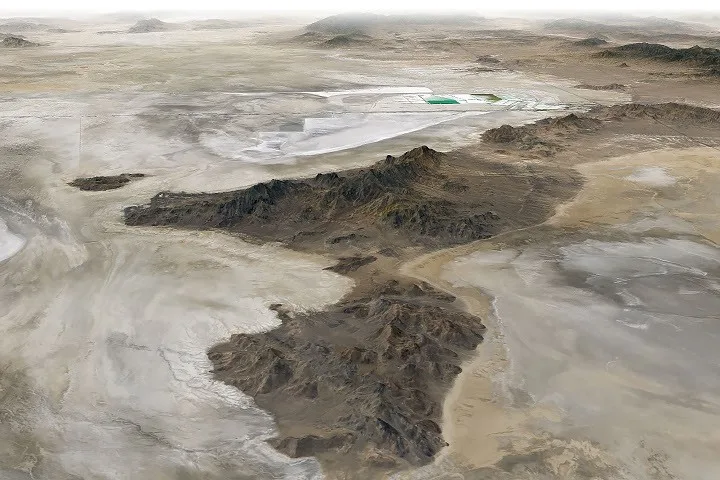
Ten thousand years ago, the Pleistocene epoch withdrew its icy fingers from the American West, leaving behind the ghost of a giant. Lake Bonneville, a colossal pluvial sea that once drowned over twenty thousand square miles of what is now Utah, Nevada, and Idaho, did not vanish quietly; it evaporated into a blinding, hyper-saline silence. What remains is a stark, calcified monument to deep time: the Bonneville Salt Flats and its sister playas. From the high-altitude perspective of modern satellite imagery—such as the stark, hyper-detailed renderings captured by NASA—this white scar on the Earth's crust resembles a minimalist canvas. It is a landscape stripped of ornament, a flat horizon of crystalline sodium chloride that has long functioned as both a geographic barrier and an irresistible blank slate for the human imagination.
For the early colonizers and overland emigrants of the nineteenth century, this dried seabed was less a marvel of geology than a crucible of pure existential dread. To venture onto the salt was to enter a sensory vacuum where the horizon shimmered with deceptive mirages and the heat warped distance into a cruel illusion. The ill-fated Donner-Reed Party of 1846 found their heavy wagons sinking axle-deep into the sticky, mud-slicked under-layers of the salt desert, a grueling delay that ultimately sealed their snowy, horrific fate in the Sierra Nevada. The playa did not merely test physical endurance; it attacked the psyche, offering nothing but the blinding glare of a primordial sun reflecting off a dead, salt-crusted womb.
> "The playa did not merely test physical endurance; it attacked the psyche, offering nothing but the blinding glare of a primordial sun reflecting off a dead, salt-crusted womb."
Yet, where the pioneers saw a purgatorial waste, the twentieth century recognized a sanctuary of frictionless speed and technological hubris. The absolute flatness of the Bonneville Salt Flats, a geometric perfection carved by ancient water, transformed the basin into the world’s premier laboratory for mechanical velocity. Here, speed-demons and visionary engineers like Ab Jenkins and Craig Breedlove pushed the boundaries of land travel, piloting jet-propelled contraptions that blurred the line between automobile and missile. To witness a vehicle hurtling across this white expanse at six hundred miles per hour is to see human ingenuity operating at its most sublime—using the calcified skeletal remains of an ancient lake to leap, however briefly, into the future of transportation.
Today, as the Great Salt Lake—Bonneville’s largest surviving remnant—shrinks to historically perilous lows, the legacy of this ancient basin takes on a more urgent, elegiac resonance. The dried playas are no longer just playgrounds for daredevils or subjects for remote satellite observation; they are quiet warnings. The dust storms that now whip off the exposed beds carry a toxic cocktail of minerals, reminding us that the disappearance of water is not merely a historical curiosity but an ongoing ecological transformation. The salt flats remain a monument of sublime indifference—a place where humanity’s grandest engineering feats and most desperate migrations are ultimately reduced to fleeting tracks on a surface that has spent millennia waiting for the water to return.