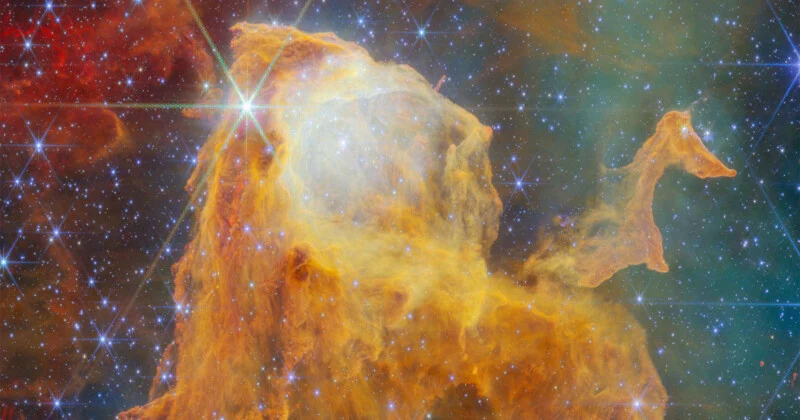
The Anatomy of a Celestial Crucible: Webb Unlocks the Carina Nebula’s ‘Treasure Chest’
On August 6, 2026, the James Webb Space Telescope peered into the chaotic, incandescent heart of the Carina Nebula and returned with a portrait of cosmic solitude that feels less like cold astrophysics and more like high baroque art. The target of this deep-space observation was a structural oddity known colloquially as the “Treasure Chest.” It is a moniker that suggests a static vault of gold, but in reality, it describes a theater of violent, beautiful creation. Located in the shadow of the nebula's famous Cosmic Cliffs, this region has long been understood as a turbulent nursery for young stars, but Webb’s infrared gaze has peeled back the obscuring veils of interstellar dust to reveal the delicate, agonizingly slow choreography of stellar birth in unprecedented clarity.
At the center of this newly released image lies a cometary globule—a deceptive astronomical term for an entity that has nothing to do with comets and everything to do with the brutal thermodynamics of the deep universe. These structures are essentially isolated, free-floating islands of dense gas and dust. They are anchored by an opaque "head" that acts as a shield, protecting nascent star systems forming within from the destructive, eroding ultraviolet radiation of nearby stellar giants. Trailing behind this protective head is a swept-back, glowing tail of luminous matter—a gossamer wake carved by the fierce stellar winds of neighboring suns. To gaze upon the Treasure Chest is to witness a masterclass in cosmic erosion; it is a monument of dust being slowly sandblasted into oblivion, even as the gravity within its darkest recesses quietly coaxes a new generation of stars into existence.
> "To gaze upon the Treasure Chest is to witness a masterclass in cosmic erosion... a monument of dust being slowly sandblasted into oblivion."
There is a poignant irony in the imagery. What Webb has unlocked is not a trove of static gems, but a fleeting moment of transition captured in the infrared spectrum—wavelengths of light invisible to the human eye but translated here into a vivid palette of crimson, gold, and deep obsidian. In the grand timeline of the cosmos, these cometary globules are highly temporary features, lasting perhaps only a few hundred thousand years before they are entirely dispersed by the very stars they helped to nurture. By capturing this ephemeral pocket of the Carina Nebula, Webb does more than gather data; it provides a profound mirror to our own curiosity. We remain a species obsessed with origins, peering into a dark, distant nursery to watch the universe construct itself, molecule by painstaking molecule, out of the remnants of what came before.