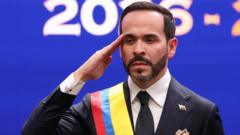
The Iron Fist of Bogotá: Washington Bets $1 Billion on Colombia’s New Crusader
A High-Altitude Coronation
The crisp, thin air of Bogotá’s Plaza de Bolívar has long served as a stage for Latin America’s most theatrical political shifts, but seldom has it hosted a performance as meticulously choreographed as the inauguration of Abelardo de la Espriella. Clad in his trademark tailored armor, the newly minted right-wing president took the oath of office not merely as a chief executive, but as an avenging crusader. In a maiden speech that vibrated with the muscular, uncompromising cadences of the continent’s resurgent hard-right, de la Espriella wasted no time in drawing his battle lines. He promised an "all-out war" on what he termed "narco-terrorism"—a phrase resurrected with renewed, venomous potency to describe the hydra-headed syndicate of drug cartels and dissident guerrillas that has long fractured the country’s periphery. It was a rhetorical tour de force designed to signal the end of conciliation and the return of the iron fist.
The Billion-Dollar Imprimatur
Washington, ever sensitive to the ideological shifts of its southern backyard, wasted no time in underwriting this new crusade. Within hours of the president’s address, the United States government announced a staggering $1 billion financial package earmarked for Colombia—a swift, transactional embrace that feels less like standard diplomatic aid and more like a high-stakes investment in a favored ideological franchise. This massive injection of capital, ostensibly aimed at bolstering security infrastructure and counter-narcotics intelligence, serves as a powerful geopolitical endorsement.
> "By immediately backing de la Espriella’s militaristic doctrine, Washington is signaling a return to the classic security playbooks of the past."
By financing this aggressive stance, the U.S. is betting that muscle, rather than the agonizingly slow work of agrarian reform and social integration, remains the most effective antidote to regional instability. It is a calculated move that reinstates Colombia as America’s premier strategic anchor in an increasingly volatile Andes.
Echoes of a Modern Crusade
Yet, beneath the triumphant fanfares of bilateral unity lies a more complicated, historically fraught landscape. De la Espriella’s martial rhetoric may thrill a middle class weary of persistent insecurity, but to historians and human rights observers, his "all-out war" threatens to unravel the delicate, imperfect tapestry of the country's ongoing peace processes. For a nation that has spent decades enduring the collateral damage of militarized anti-drug strategies, the resurrection of "narco-terrorism" as the primary organizing principle of statecraft feels like a regression to a painful era. By framing a deeply rooted socio-economic crisis as a purely military equation—and with a billion dollars of American hardware now poised to back that theory—the de la Espriella administration is embarking on a path where the line between peace-building and pacification becomes perilously thin.