The Fragile Canopy: Unprecedented Deluge Shatters Japan’s Tech-Infused Solace
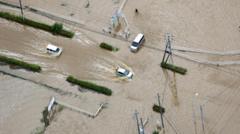
For generations, Japan has engineered its urban landscapes to withstand the caprices of a temperamental earth, constructing a marvel of seismic dampers, seawalls, and subterranean cisterns designed to master the elements. Yet, nature retains a cruel capacity for rewriting the limits of human anticipation. This week, a deluge of what meteorologists have termed "unprecedented" intensity descended upon the archipelago, transforming streets into roiling, mud-slicked canals and leaving at least four people dead in its wake. The tempest was not merely a meteorological anomaly; it was a violent rupture of the quiet contract between a highly organized state and the volatile climate of the twenty-first century. As hillsides dissolved and rivers breached their banks, the meticulously calibrated rhythms of Japanese daily life were abruptly suspended, replaced by the stark, ancient drama of survival against a rising tide.
The vulnerability of this hyper-engineered society was nowhere more visible than at Tokyo’s Narita International Airport, a glittering monument to global transit that was suddenly reduced to a high-tech purgatory. More than 7,000 travelers found themselves stranded overnight, cocooned in terminal buildings that became islands of stymied ambition, while the runways outside slicked under the relentless downpour. Meanwhile, across the eastern prefectures, the electrical grid flickered and died, plunging more than 20,000 households into a sudden, pre-industrial darkness. In the neon-lit heart of the world’s most sophisticated metropolis and its surrounding suburbs, the silence of dead screens and cold appliances served as a sobering reminder of how quickly the veneer of modern comfort can be peeled away by the raw velocity of water.
Historically, Japanese culture has maintained a profound, poetic dialogue with the transient beauty of the seasons—a philosophy of mono no aware, or the pathos of things. But there is nothing poetic about the Anthropocene's chaotic feedback loops. This latest catastrophe underscores an unsettling truth for a nation that has long prided itself on its peerless, disaster-ready infrastructure: the parameters of crisis are shifting faster than the blueprints can be updated. As rescue workers sift through the debris and the floodwaters slowly recede, the nation is left to contemplate a future where the "unprecedented" is no longer a historical outlier, but the baseline. In this new era, the formidable engineering that once seemed to guarantee permanence looks increasingly like a temporary dam against an inevitably rising tide.