A Dying Planet’s Neon Shroud: The Tragic Beauty of Martian Auroras
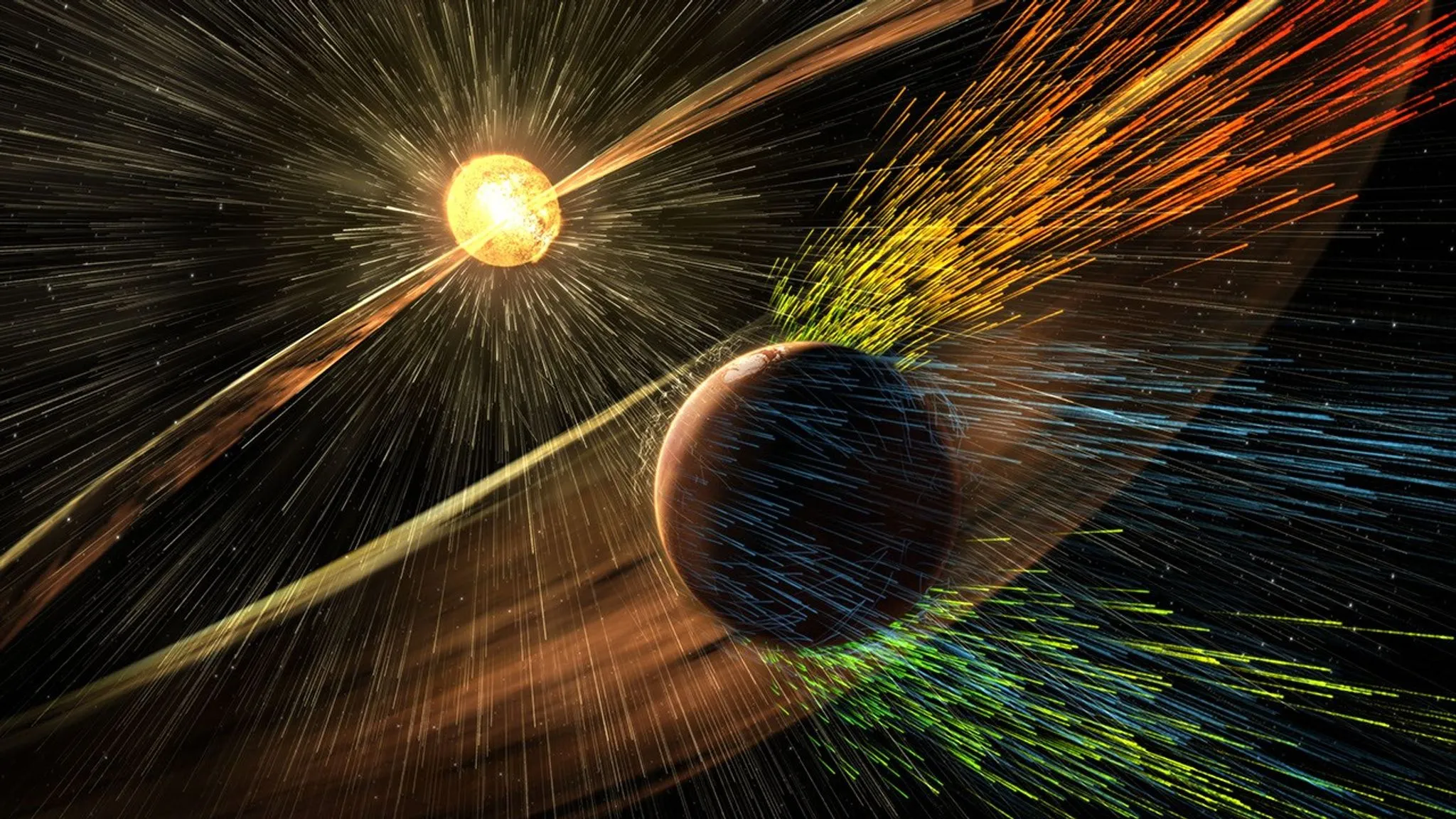
Mars is a monument to cosmic erosion. Unlike Earth, which wears its robust magnetosphere like a protective armor, the Red Planet lies largely naked to the solar wind, a dry husk vulnerable to the whims of our parent star. In July 2026, data and visualizations released from NASA’s MAVEN (Mars Atmosphere and Volatile Evolution) mission illuminated this vulnerability with startling clarity, revealing how the planet’s ghostly auroras are actually the exquisite byproduct of its slow-motion destruction. When solar storms lash Mars, they do not merely trigger harmless celestial light shows; they actively peel away the Martian atmosphere, leaving a glowing trail of theft in their wake.
For over a decade, the MAVEN spacecraft has quietly orbited this rusted world, acting as a post-mortem chronicler of its lost warmth and ancient water. The mission’s latest insights draw a direct, elegant line between atmospheric escape and the genesis of Martian auroras. Scientists have discovered that certain types of these diffuse glows are ignited by the very same mechanism that is robbing Mars of its air: the relentless bombardment of charged solar particles. As these high-energy streams collide with the planet’s sparse remaining gases, they excite the atmosphere to emit a faint, ethereal light, even as they simultaneously strip those same molecules away into the dark vacuum of space. It is a hauntingly beautiful feedback loop—a planetary sigh rendered in neon.
In the grand ledger of the cosmos, the Martian aurora is less an ornament than an obituary. Where Earth’s northern and southern lights are celebrated as dynamic proofs of our planet’s vital electromagnetic shield, the auroral glows of Mars are the embers of a cold hearth. This discovery reframes our understanding of planetary evolution, suggesting that the light shows of alien worlds may often be the signatures of their unraveling. To look upon the Martian sky during a solar storm is to witness a world being disassembled in real-time, illuminated by the very forces that destroy it—a stark, poetic reminder of the fragile boundaries that separate a living world from a barren monument.