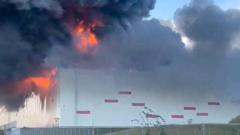
For a nation that has spent more than two years attempting to maintain a veneer of metropolitan normalcy amidst an grueling war of attrition, the digital conveyor belts of Russia’s consumerist dreamscape have suddenly become a theater of violence. In a series of highly targeted drone strikes, Ukrainian forces have hit key logistics facilities operated by Wildberries—Russia’s ubiquitous, homegrown answer to Amazon—stretching from the imperial waterways of St. Petersburg to the industrial corridors of Tver. The attacks represent a calculated strike not just against physical infrastructure, but against the very illusion of domestic insulation. For the Russian middle class, Wildberries is more than a retailer; it is a psychological lifeline, a purple-and-pink-branded monolith that has kept the flow of globalized goods moving despite heavy Western sanctions. To see its sprawling distribution hubs reduced to smoldering husks is to watch the war puncture the fragile bubble of everyday Russian convenience.
While logistics hubs burned in the provinces, a far more lethal reality manifested on the periphery of the capital. In the Moscow region, a synchronized strike claimed the lives of five people, bringing the physical toll of the conflict directly to the doorstep of the ruling elite. This escalation underscores a shifting geography of vulnerability. The frontline is no longer a distant, abstract concept confined to the muddy trenches of the Donbas; it is a kinetic presence capable of falling from the sky into residential suburbs and corporate distribution centers alike. The strikes reveal a Ukrainian military increasingly adept at exploiting gaps in Russian air defenses, systematically mapping the logistical arteries that sustain both the Russian economy and the daily lives of its citizens.
```
"To strike at Wildberries is to strike at the domestic contract of the modern Russian state—the promise that the war can be waged in the background while the comforts of the consumer class remain uninterrupted."
```
The symbolic weight of targeting Wildberries cannot be overstated. Founded by Tatyana Bakalchuk, once celebrated as Russia’s self-made tech billionaire, the company has long been showcased by the Kremlin as a triumph of domestic resilience under economic siege. By turning these massive fulfillment centers into tactical targets, Kyiv is sending a clear message: in a total war, the infrastructure of commerce is indistinguishable from the infrastructure of state survival. As smoke rises over the warehouses of Tver and the residential blocks of the Moscow region, the Kremlin's narrative of a distant and contained "special military operation" is steadily dismantled, replaced by the grim realization that no amount of digital convenience can shield a nation from the consequences of its own foreign policy.