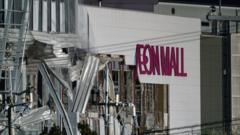
The Price of Paper: Tragic Mall Blast Exposes the Fatal Priorities of Corporate Duty
In the bruised aftermath of tectonic upheaval, when the earth itself has rebelled, there remains a chilling, fragile insistence on human order—specifically, the unyielding order of commerce. The ruins of the Aeon Mall, a sprawling cathedral of modern consumerism now fractured by Japan’s latest seismic shudder, should have been treated as a zone of absolute evacuation, a place where life was prioritized over ledger sheets. Instead, it became a tomb for two female employees. Sent back into the structural wreckage not to rescue survivors or administer vital aid, but to perform the ultimate, desperate rite of retail preservation—securing the cash registers—the workers were killed when a sudden, violent explosion ripped through the unstable complex.
This tragedy lays bare the dark, silent compromise that underpins much of the modern workplace: a devotion to institutional duty that too easily morphs into a fatal obligation. In Japan, where the cultural gravity of obedience and hierarchical loyalty is woven into the very fabric of social survival, a command from a superior is rarely met with defiance, even when the air is thick with dust and the threat of aftershocks. The employer’s subsequent public apology—delivered with the curated, solemn bows of corporate contrition—feels devastatingly inadequate. It is a grim reminder that in the cold calculus of retail operations, the physical safety of labor is too often weighed against the preservation of capital, with the latter deemed the more urgent asset to salvage from the ruins.
```
"The tragedy stands as a harrowing parable of modern labor, where the relentless demand to protect the margin persists even as the ground liquefies beneath our feet."
```
The blast itself was a violent, sudden punctuation mark on an already catastrophic day, likely triggered by ruptured gas lines or compromised infrastructure that turned the shattered mall into a tinderbox. These two women were not trained emergency responders equipped with protective gear; they were ordinary workers thrust into the line of fire by a management class insulated from the physical perils of the shop floor. As investigators piece together the sequence of decisions that led to this avoidable disaster, the incident transcends a mere breach of safety protocol. It stands as an indictment of a systemic worldview that struggles to distinguish between human life and the paper currency meant to measure it.