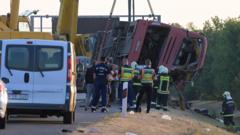
Tragedy on the Asphalt: Twelve Dead as Polish Tourist Bus Overturns in Hungary
In the liminal, pre-dawn hours of Sunday morning, when the gray arteries of the Central European motorway system are at their quietest, tragedy has a way of striking with a swift, merciless indifference. On a desolate stretch of Hungarian asphalt, a Polish charter bus—carrying travelers bound for the fleeting sanctuary of a summer holiday—veered violently off the road and overturned. The catastrophic accident left twelve dead and dozens of others seriously injured, transforming a routine journey of leisure into a scene of sudden, kinetic horror. The vehicle, once a vessel of quiet sleep and shared anticipation, was reduced in an instant to a crumpled monument of steel and shattered glass.
The Anatomy of an Aftermath
Emergency services arriving at the scene before the first light of day were met with a landscape of profound disorientation. First responders described a harrowing tableaux: scattered luggage, discarded personal effects, and the frantic, echoing cries of survivors trapped beneath the heavy chassis. The injured, numbering more than thirty, were swiftly triaged and rushed to regional hospitals, their sudden transition from holidaymakers to trauma patients mirroring the abruptness of the crash itself. For the rescue crews working under the harsh glare of floodlights, the immediate task was one of grim extraction, operating against the clock to pull survivors from a metal labyrinth that had overnight become a tomb.
The Fragile Covenant of Transit
While the precise mechanics of the disaster remain the subject of an intense investigation by Hungarian authorities, the tragedy speaks to a quiet, lingering anxiety inherent in the modern European project of seamless, cross-border mobility. The long-distance charter bus remains the democratic workhorse of continental tourism, transporting families, retirees, and budget-conscious travelers across vast distances on the promise of affordable discovery. When such a vessel fails, it ruptures more than just the lives of those on board; it disrupts the unspoken covenant of safety that underpins our highly interconnected lives.
As Polish and Hungarian officials coordinate the somber logistics of repatriation and grief counseling, this dark stretch of motorway stands as a solemn memento mori. It is a stark reminder that beneath the polished veneer of modern transit lies a persistent, fragile vulnerability—one that can turn a journey of joy into a historic grief in the span of a single, drifting second.