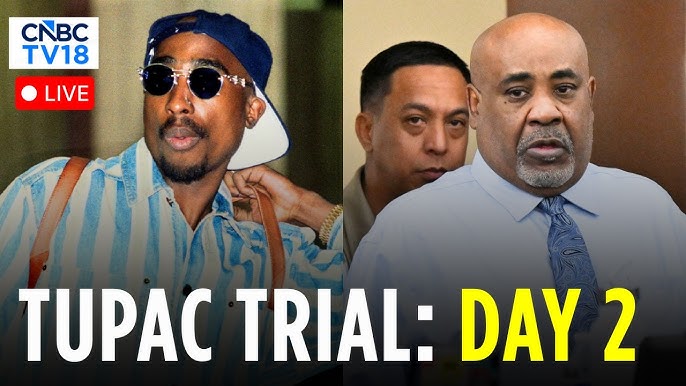
The Ledger of Legend: Duane 'Keefe D' Davis and the Late Reckoning of Las Vegas
In the sterile, fluorescent-lit confines of a Clark County courtroom, far removed from the sun-bleached asphalt and neon-drenched excess of the 1996 Las Vegas Strip, a thirty-year-old ghost has finally been subpoenaed. As the murder trial of Duane "Keefe D" Davis marched into its second day, the atmosphere carried the heavy, melancholic weight of a historical autopsy. For decades, the slaying of Tupac Shakur existed not as a cold case, but as a foundational American myth—a tragedy of Shakespearean proportions played out in the key of G-funk. Now, the state of Nevada is attempting to do what folklore never could: reduce a cultural watershed to a series of dry, prosecutorial exhibits.
```
"The tragedy of Tupac Shakur was always a story told in the key of myth. In this courtroom, the state is attempting the impossible: translating street-level retribution into the clinical ledger of the law."
```
Day Two of the proceedings arrived on the heels of opening arguments that felt less like legal preludes and more like the unspooling of a tragic, retro-active epic. Davis, now grey-haired and stripped of the swagger that characterized his infamous late-career media tours, sat as a quiet, almost anachronistic figure. For years, he operated under the assumption that the passage of time and the unwritten codes of the street had granted him a perverse kind of immunity. His own boasts, preserved in memoirs and televised confessionals, have become the cornerstone of the prosecution's cage. If Day One established the grand narrative arc—the collision of Death Row Records and the South Side Compton Crips—Day Two promised the grinding, necessary machinery of evidence: the forensics of a drive-by, the mapping of old territories, and the tedious reconstruction of a night that redefined global music culture.
There is a profound, almost tragic irony in the timing of this trial. The world that produced both Shakur and Davis has largely been paved over; the raw, analog hostility of the nineties rap wars has been digitized, commodified, and archived. Yet, inside the courtroom, the stakes remain searingly immediate. The prosecution's task is to prove that Davis was the orchestrator, the "on-set commander" who handed down the weapon that silenced one of the twentieth century’s most vital poetic voices. For the gallery, packed with aging hip-hop purists, legal scholars, and curious onlookers, the trial is a reminder of the fragility of justice. It is an attempt to balance a ledger that many believed would remain forever open, proving that even in a city built on the fleeting illusions of the jackpot, some debts are eventually called due.