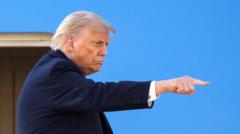
The Shadow on the Tarmac
The tarmac has long served as the primary stage-set for Donald Trump’s singular brand of political theater, a place where the gleaming fuselage of "Trump Force One" operates as both a monument to personal branding and a battering ram of populist ambition. Yet, a recent, sudden swap of aircraft—replacing his signature, gold-plated Boeing 757 with a more anonymous, charter-grade vessel—revealed a starker reality lurking beneath the campaign pageantry. This was not a routine logistical pivot, but rather a chilling concession to the grim calculus of modern asymmetrical warfare. The sudden shift in aviation protocol underscores a haunting truth: for the former president, the geopolitical hostilities of the Middle East are no longer distant policy debates, but an intimate, existential threat trailing him across the American skies.
A Legacy Written in Embers
The origins of this high-stakes aerial choreography trace back to January 2020, to a rain of fire on a Baghdad airport road that claimed the life of Major General Qasem Soleimani, the architect of Iran’s regional shadow empire. In ordering that strike, Trump did not merely disrupt the chessboard of Middle Eastern statecraft; he initiated a deeply personal vendetta with a regime that possesses a notoriously long memory and a theological commitment to vengeance. Where conventional statesmen view international relations through the sterile lens of institutional diplomacy, Trump has always operated on instinct, personality, and transactional loyalty. Now, that highly personalized style of governance has yielded an equally personalized blowback, transforming his campaign trail into a labyrinth of heightened security briefings, counter-sniper teams, and tactical evasions.
> "The borders of global conflict have collapsed, bringing the frontlines of a cold war with Tehran directly to the runways of regional American airports."
The Private Citizen and the Sovereign Threat
There is a dark irony in the spectacle of a billionaire populist, who built an empire on the conspicuous display of his own name, being forced to dim his marquee lights to evade foreign intelligence. Intelligence briefings detailing active, state-sponsored Iranian plots against his life have effectively blurred the boundary between private campaign logistics and national security defense. This is no longer merely about securing a political candidate; it is about defending a high-value sovereign target from an adversarial nation-state on domestic soil. The dramatic swap of aircraft serves as a physical manifestation of this threat—a visual testament to a reality where a former commander-in-chief must treat the domestic airspace as a potentially hostile theater.
Ultimately, this quiet drama on the tarmac speaks to a broader, more unsettling shift in the nature of contemporary global power. In an era where cyber warfare, proxy militias, and targeted assassinations have supplanted traditional battlefield maneuvers, the distinction between wartime and peacetime has evaporated. Trump's compromised mobility is a stark reminder that in the twenty-first century, the consequences of executive decisions do not expire when an administration leaves office. As he campaigns for a return to the White House, the very vessel that symbolizes his global ascent must now be cloaked, leaving him to navigate a landscape where the pursuit of power is inextricably bound to the preservation of survival.