The Sky as Stage: Inside Donald Trump’s High-Altitude Theater of Risk
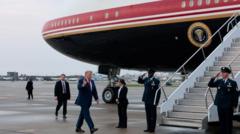
There is a distinct, metallic theater to the architecture of modern presidential travel—an expensive choreography of decoy motorcades, armored glass, and the iconic, blue-and-white silhouette of Air Force One. Yet, following the close of a characteristically fractious NATO summit, this choreography dissolved into a high-altitude drama of Donald Trump’s own telling. Citing an unspecified, whispered menace, the former president revealed he had abruptly abandoned his primary aircraft for an alternate vessel. It was a mid-tarmac pivot that swapped the supreme, heavily fortified symbol of American executive power for a less conspicuous transport, transforming a routine departure into a cinematic escape from an invisible adversary.
But in the singular lexicon of Trumpian self-narrativization, a tactical retreat is never merely a safety precaution; it is an invitation to court a grander jeopardy. Trump later observed, with a characteristic blend of conspiratorial gravity and defiant bravado, that the decoy Air Force One he left behind was actually the safer bet. The jet he ultimately boarded instead, he claimed, was exposed to "greater risk"—an assertion that reframes the entire episode from a standard Secret Service contingency into an act of personal daredevilry. By his logic, the security apparatus designed to shield him had inadvertently funneled him into a pocket of heightened vulnerability, leaving him suspended in the cold stratosphere, uniquely exposed.
This rhetorical maneuver highlights a familiar, potent theme in the Trumpian political theater: the weaponization of perceived peril. For Trump, danger is not a condition to be quietly mitigated by anonymous agents in earpieces, but a narrative currency to be spent before an audience. By painting his alternate flight path as a gamble against steeper odds, he elevates a bureaucratic detour into a brush with destiny. The sky ceases to be a mere medium of transit and becomes a stage where the protagonist must navigate a gauntlet of unseen threats, reinforcing his enduring political mythology as the perpetually targeted outsider who braves the hazards his detractors merely watch from the safety of the tarmac.
As the aircraft climbed into the grey European cloud cover, leaving the diplomatic stage of NATO behind, the episode lingered as a potent metaphor for his broader political existence. Whether the threat was a sober intelligence assessment or an overabundance of caution, it was instantly absorbed into the larger, churning engine of his public persona. In this world, safety is a bureaucratic illusion, the state’s protections are inherently flawed, and the leader must always fly directly into the headwind of the greatest danger, claiming the turbulence as his own.