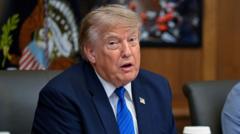
The Art of the Reprieve: Trump’s Theatre of Brinkmanship in the Persian Gulf
In the theatre of twenty-first-century American hegemony, geopolitical conflict has increasingly assumed the erratic, high-suspense cadence of a prime-time cliffhanger. Once again, Donald Trump has pulled the world back from the precipice of military confrontation with Iran, transforming what appeared to be an imminent escalatory strike into a characteristic exercise in transaction and suspense. According to the President, the machinery of American shock and awe was halted at the eleventh hour, not by strategic second thoughts or bureaucratic friction, but by a chorus of pleading voices from Tehran and across the Middle East, all claiming that the "perimeters" of a grand diplomatic breakthrough had suddenly fallen into place. By framing this military de-escalation as a conditional stay of execution—subject to a new deal being struck "rapidly"—Trump has once again recast the terrifying machinery of state-sanctioned violence as merely the opening bid in a chaotic real estate negotiation.
This narrative of eleventh-hour supplication is classic Trumpian mythology, a vivid tableau in which adversaries and allies alike are depicted as begging Washington for mercy. It is a worldview that rejects the dry, institutional gravity of traditional diplomacy in favor of sheer personal dominance. To suspend a military strike on the vague promise of a swift, undefined accord is to treat the volatile, centuries-old animosities of the Persian Gulf as a distressed asset awaiting liquidation. The administration’s insistence on immediacy injects a deliberate, calculated instability into the region; it keeps both Tehran and international observers in a state of permanent, anxious suspension where peace is never a stable architecture, but rather a temporary lease subject to renewal by executive whim.
> "By framing the reprieve as a stay of execution contingent on a 'rapidly' brokered deal, Trump has recast the terrifying machinery of state-sanctioned violence as merely the opening bid in a chaotic negotiation."
For foreign policy traditionalists, this sudden retreat will be parsed as a symptom of a presidency devoid of a coherent doctrine—a jittery oscillation between bellicose bluster and isolationist retreat. Yet, for the administration, the strategic utility lies precisely in this performance of mercurial restraint. By publicizing both the threat of the strike and the magnanimity of its withdrawal, Trump achieves the domestic theater of strength without incurring the messy, unpredictable body count of actual warfare. The aborted strike becomes a potent ghost in the machine: an invisible sword hanging over Iran, suspended by a single, fragile thread of presidential patience. Ultimately, this episode reveals a leadership style that views global brinkmanship not as a delicate balance of deterrents, but as a series of high-stakes climaxes, where the ultimate prize is the spectacle of the adversary being forced to sue for peace on the clock.