The View from Above: The Gemini Visual Acuity Experiments
In May 1963, suspended in the claustrophobic aluminum capsule of the Faith 7, astronaut L. Gordon Cooper, Jr. looked out into the abyss and saw, to the astonishment of the scientific establishment below, the mundane choreography of human life. Cooper was orbiting at some 17,500 miles per hour, yet through his small double-pane window, he claimed to resolve the seemingly impossible: dust-kicking trucks traversing Tibetan mountain passes, the dark, slow-moving sutures of trains pulling plumes of white smoke across the plains, and the thin veins of dirt roads cut into the wilderness. To a medical community accustomed to treating the human eye as a delicate, easily deceived optical instrument, Cooper’s 29 color photographs and vivid anecdotes seemed less like scientific observation and more like the fevered hallucinations of a man intoxicated by the sublime loneliness of low Earth orbit.
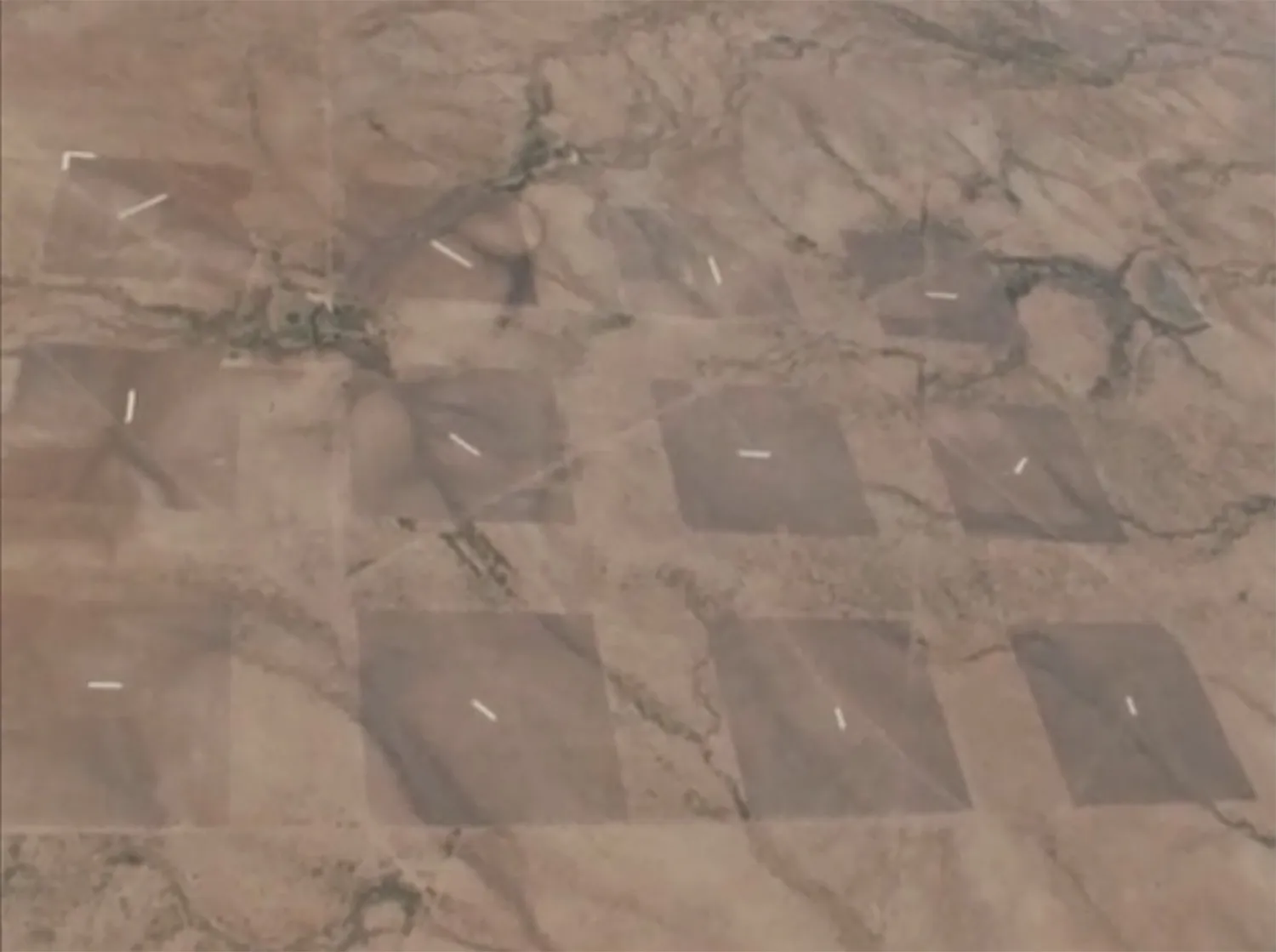
The tension between subjective wonder and objective verification gave rise to the Gemini Visual Acuity Experiments, a series of elegant, highly controlled tests designed to map the true parameters of human sight in the vacuum of space. Critics argued that atmospheric distortion, cabin glare, and the blinding speed of orbital flight should reduce the Earth's surface to an illegible smear. To settle the debate during the Gemini V and VII missions, NASA transformed the terrestrial landscape into a giant eye chart. In the arid expanses of Laredo, Texas, and Western Australia, researchers laid out massive, high-contrast plaster targets—patterns of parallel white bars set against dark soil. As astronauts Gordon Cooper and Pete Conrad hurtled overhead, they were tasked with discerning the orientation of these lines, turning the simple act of looking into a rigorous exercise of cosmic geometry.
> "In an era increasingly dominated by the cold, mechanical precision of telemetry, the Gemini experiments proved that the human eye remained a peerless instrument of discovery."
The results ultimately vindicated the celestial travelers. Not only could the astronauts identify the targets with startling precision, but their visual acuity in the pristine, weightless environment of the spacecraft cabin remained virtually unimpaired, occasionally even exceeding their baseline performance on Earth. This revelation did more than merely validate Cooper's initial, romantic assertions; it reframed the astronaut not as a passive passenger or a mere pilot, but as an active, sophisticated sensor. In an era increasingly dominated by the cold, mechanical precision of telemetry and automated imaging, the Gemini experiments proved that the human eye, sharpened by the stark contrasts of space, remained a peerless instrument of discovery. It suggested that when we stepped into the cosmos, we did not leave our sensory connection to the Earth behind; rather, the distance only served to render the details of our home more achingly clear.