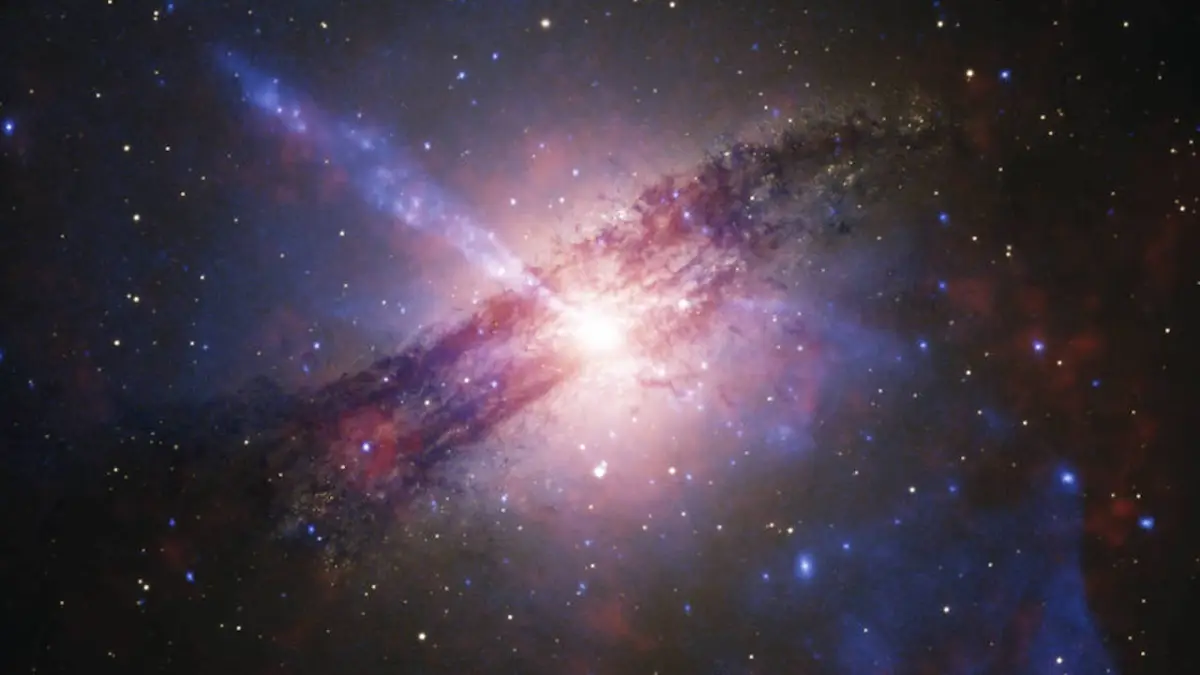
The Anatomy of a Cosmic Ghost: Webb Peers Through the Dust of Centaurus A
To look into the night sky is to engage in a form of celestial archaeology, but rarely does the deep past feel so violently present as it does in the vicinity of Centaurus A. Sitting a mere eleven million light-years away—a stone’s throw in the vast ledger of the cosmos—this galaxy has long teased astronomers with its turbulent silhouette. In a newly released observation captured on July 6, 2026, NASA’s James Webb Space Telescope turned its formidable Mid-Infrared Instrument (MIRI) toward this cosmic anomaly, piercing the thick shrouds of interstellar dust that have historically obscured its inner workings. What emerged is not merely an astronomical data point, but a visceral portrait of a system caught in the throes of a profound, self-consuming renaissance.
Where optical telescopes see only a dark, impenetrable belt of dust slicing through a brilliant elliptical core—the scarred remains of an ancient galactic merger—Webb’s infrared vision reveals a nursery of fire. MIRI operates in a spectrum where cold dust glows and hidden kinetic energy becomes legible. The telescope’s latest imagery strips away the opaque velvet of the foreground dust to expose a complex web of gas, young star clusters, and the furious winds whipped up by a central supermassive black hole. It is a starburst galaxy laid bare, showing how the collision of gas clouds catalyzes the birth of new stellar systems at a frantic, agonizingly beautiful pace.
In the grand taxonomy of the universe, Centaurus A exists as an exquisite paradox: a giant elliptical galaxy, typically the quiet retirement home of the cosmos, behaving with the chaotic, youthful vitality of a starburst system. This restlessness is what draws the scientific imagination. By capturing the intricate dynamics of this nearby neighbor with unprecedented clarity, Webb does more than deliver an aesthetic marvel; it provides a blueprint for the lifecycle of galactic matter. The dust we observe is not mere debris, but the raw currency of future worlds, recycled through the violent forge of stellar birth and demise.
Ultimately, this dispatch from the edge of the infrared spectrum serves as a reminder of our own technological audacity. In the glowing, turbulent structures of Centaurus A, we do not just witness the physics of star formation; we gaze into the mirror of our own chemical origins. Webb's latest observation is a triumph of technical precision, proving once again that in the vast, silent dark of the universe, the most profound revelations are those that require us to see the invisible.