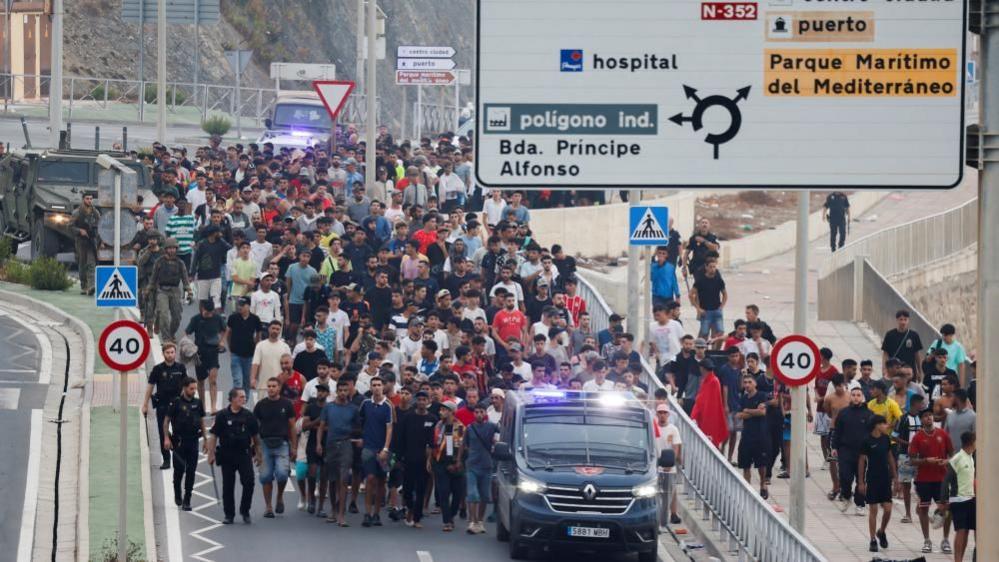
The Fractured Frontier: How the Sands of Ceuta Exposed the Sclerotic Soul of Europe
The Spanish enclave of Ceuta, a sun-bleached outpost of razor-wire and geopolitical friction grafted onto the Moroccan coast, has once again become the stage for a tragic theater of human desperation and European fracture. As hundreds of migrants risked their lives to breach the maritime border, the immediate response from the continent’s capitals revealed a familiar, grim choreography. Instead of a unified humanitarian or administrative strategy, the crisis has triggered a sharp diplomatic schism. In Rome, Prime Minister Giorgia Meloni seized upon the chaotic images—which she termed "shocking"—to justify a drastic measure: the temporary suspension of the Schengen agreement with Spain. It was a swift, unilateral reassertion of national sovereignty that effectively severed, if temporarily, one of the most sacred arteries of European integration.
Madrid’s response was swift, laced with a biting indignation that laid bare the profound ideological chasm dividing the Mediterranean's northern shores. Spanish officials pointedly condemned the "selfish" reflex of their European neighbors, arguing that Rome's retreat behind reinstated borders is a betrayal of the block’s foundational promise. For Spain, the crisis at Ceuta is not merely a localized security breach to be quarantined, but a shared European responsibility. By treating the migration influx as an isolated Spanish failure rather than a systemic continental challenge, countries like Italy, Madrid argues, are indulging in a convenient, short-sighted isolationism that leaves frontline states to shoulder the human and administrative weight of a continent's collective border anxieties.
```
"The suspension of Schengen is not a security solution; it is a political performance staged at the expense of European solidarity."
```
Under Meloni’s right-wing administration, Italy has increasingly positioned itself as the sentinel of a fortress under siege, utilizing border policy as a potent instrument of domestic political theater. The suspension of free movement under Schengen, ostensibly enacted to prevent secondary migration flows, serves a deeper narrative: the assertion of the nation-state over the perceived failures of Brussels. This friction exposes a deeper hypocrisy at the heart of the European project. While the European Union prides itself on a rhetoric of universal human rights and seamless internal mobility, its external borders remain heavily securitized, outsourced, and contested. When those borders are breached, the veneer of cosmopolitan unity quickly dissolves into a primal scramble for self-preservation.
Ultimately, the escalating rhetoric between Madrid and Rome reveals a deeper, existential malaise within the European Union. The sands of Ceuta have become a mirror reflecting a continent deeply divided over its own identity and future. As Spain calls for empathy and shared accountability, and Italy retreats behind the protective walls of national borders, the migrants caught in the middle remain symbols of a crisis that Europe can neither resolve nor ignore. The dream of a borderless, unified Europe is increasingly look like a luxury of stable times—one that is easily discarded when the realities of global migration arrive at the gate.