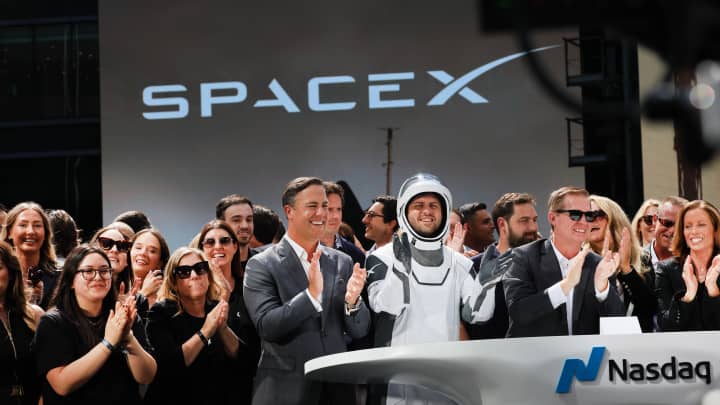
Gravity Defied: Why the Smart Money is Betting SpaceX Has Found Its Floor
In the arcane, highly gatekept world of secondary private markets, a "lock-up expiration" is usually treated with the anxious, breath-holding anticipation of a controlled demolition. It is the moment early investors and insiders, long constrained by regulatory handcuffs, are finally permitted to liquefy their paper wealth—a sudden rush of supply that almost invariably drags share prices down to earth. Yet, on Thursday, Elon Musk’s SpaceX performed another of its signature defiance-of-gravity acts. As the lock-up provisions governing a significant tranche of its privately held shares expired, the market braced for a downward correction. Instead, the stock ticked stubbornly upward. It was a subtle but profound display of market resilience, signaling to the financial class that the insatiable appetite for the world's premier aerospace pioneer is far from sated.
To understand the significance of this holding pattern is to understand how SpaceX has transcended its status as a highly valued startup to become an essential proxy for the future of off-world commerce. While the broader technology sector grapples with high interest rates and the sobering realization that terrestrial artificial intelligence requires unprecedented, unproven capital expenditure, SpaceX remains anchored by tangible, monopolistic utility. Between the unrelenting launch cadence of its Falcon 9 fleet and the global infrastructural hegemony of Starlink, the company operates less like a speculative venture and more like an indispensable, extra-atmospheric utility. For the family offices and boutique institutional desks trading these shares in the shadows of the secondary markets, Thursday's price action was not merely a good trading session; it was a validation of a formidable valuation floor.
> "By absorbing the potential deluge of seller liquidity on Thursday and marching higher, SpaceX demonstrated that its financial trajectory is increasingly decoupled from terrestrial anxieties."
Indeed, for the sophisticated traders who orchestrate these private placements, the consensus is hardening: the bottom is officially in. The willingness of buyers to eagerly absorb the newly unlocked supply without demanding a steep discount suggests a deep, structural confidence. In a macroeconomic environment starved for genuine, high-conviction growth narratives, SpaceX has evolved into the ultimate defensive-aggressive play—a hedge against Earth-bound stagnation. By closing the session higher, the rocket company proved that its financial trajectory, much like its ambitious Starship prototypes, is powered by a momentum that traditional market gravity can no longer easily pull down.