The New Celestial Cartography: South Korea’s Orbiter Captures the Scars of Private Spaceflight
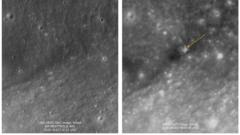
The Moon, long romanticized as an untouchable, silver sentinel of our night sky, is rapidly transforming into a gallery of human scars. In a striking demonstration of cosmic forensic photography, South Korea’s lunar orbiter, Danuri, has captured stark "before and after" images of a desolate lunar plain forever altered by the detritus of billionaire-funded ambition. The subject of the frame is a fresh, jagged crater—the violent signature of a spent SpaceX rocket booster that collided with the lunar surface. Where once lay undisturbed regolith, untouched since the dawn of the solar system, there is now only the messy, metallic footprint of modern Earth’s commercial space race.
```
"The images captured by Danuri are a silent, haunting testament to an era where the boundary between exploration and littering has begun to blur."
```
This celestial collision, documented with chilly precision by the Korea Aerospace Research Institute (KARI), represents more than a mere mechanical mishap; it is a milestone in the anthropocene’s expansion beyond our atmosphere. The discarded rocket stage, traveling at thousands of miles per hour, plowed into the far side of the Moon, sending shockwaves through a vacuum that has known only the slow, silent passage of eons. By capturing the precise moment of this transformation, Seoul’s orbiter has not only proved its own formidable technological mettle but has also served as an impartial witness to the sheer untidiness of our rush to the stars. The images reveal a bright halo of ejected subsurface soil, a stark contrast to the darker, weathered dust of the lunar highlands, gleaming like a fresh wound.
Politically and culturally, the event underscores a profound shift in the geopolitics of the cosmos. No longer is space exploration the exclusive, highly controlled domain of Cold War superpowers operating under the austere banner of national prestige. Today, the lunar environment is a crowded frontier shared by emerging space powers like South Korea—determined to assert their sovereignty in the high orbit—and private conglomerates whose balance sheets dictate the trajectory of human discovery. The presence of SpaceX debris on the Moon is a vivid reminder that the privatization of the heavens carries a physical cost, leaving a trail of high-tech wreckage across pristine celestial bodies.
As Danuri continues its lonely, circular vigil, mapping the lunar terrain for future Korean missions, it leaves us with a unsettling mirror of our own terrestrial habits. The pristine wilderness of the Moon is slowly yielding to the same chaotic, industrial human sprawl that has reshaped the continents of Earth. South Korea’s lens has captured a glimpse of our future: a sky no longer defined by distant, glittering myths, but by the tangible, metallic echoes of our own restlessness.