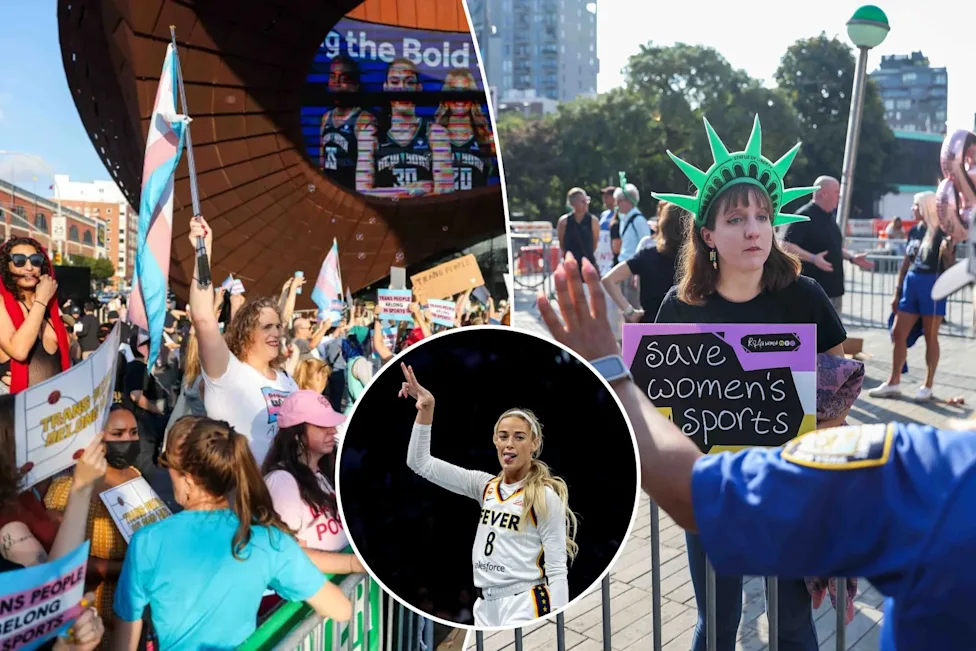
The Hardwood Schism: Inside the Clash of Culture and Identity Outside Barclays Center
On a grey Brooklyn Saturday, the concrete plaza of the Barclays Center—traditionally a temple of athletic escapism—metamorphosed into an ideological fault line. The catalyst was the volatile debate over transgender athletes, recently thrust back into the cultural slipstream by Phoenix Mercury guard Sophie Cunningham. Though the afternoon’s marquee event was a highly anticipated matchup between the Indiana Fever and the New York Liberty, the court itself felt secondary to the theater of polarization unfolding on the pavement. Ahead of tip-off, rival factions converged outside the arena’s towering glass facade: on one flank, trans rights activists holding pastel-striped flags and chanting slogans of inclusion; on the other, a vocal assembly of Cunningham’s defenders wielding placards demanding the preservation of "biological fairness" in women's sports. It was a stark, clamorous tableau of a society unable to find a common language, let alone common ground.
The confrontation was emblematic of a larger, more turbulent shift within women’s basketball. Long celebrated as a progressive vanguard—a league that championed civil rights, queer visibility, and systemic reform long before such stances were corporate-approved—the WNBA now finds itself grappling with the anxieties of its own mainstream success. On the Brooklyn pavement, this tension was palpable. The pro-trans demonstrators, organized and resolute, spoke in the urgent vocabulary of human rights and bodily autonomy, framing the exclusion of trans women as an existential threat to the league’s foundational ethos of radical acceptance. Conversely, the counter-protesters, galvanized by Cunningham’s polarizing rhetoric, weaponized the language of Title IX, framing their advocacy not as bigotry, but as a defense of historical feminism and the integrity of female athletic spaces.
> "We are witnessing the conscription of women's sports into a broader, cynical political theater," observed one local spectator, watching the scene unfold from the perimeter. "The game is no longer just a game; it is a proxy war."
As the arena doors opened and the low bass of the pre-game warmups began to reverberate through the plaza, the shouting match outside reached its crescendo, yet resolved nothing. This is the new reality of the WNBA—a league no longer insulated by its niche status, but thrust into the blinding, unforgiving glare of the national culture war. Players like Cunningham, whether by calculated design or incidental expression, have become lightning rods, their names transformed into shorthand for deeply entrenched political beliefs. Inside the arena, the sneakers squeaked on the hardwood and a sellout crowd roared for layups; outside, the placards remained hoisted in the dimming afternoon light, a vivid reminder that the most consequential battles in modern sports are no longer decided by the final buzzer, but by the relentless, unyielding currents of the society swirling around them.