The Golden Strangling of the Atlantic
As the Great Atlantic Sargassum Belt reaches suffocating new heights, the tropical paradise of the Americas faces a reckoning written in rust-colored weeds.
***
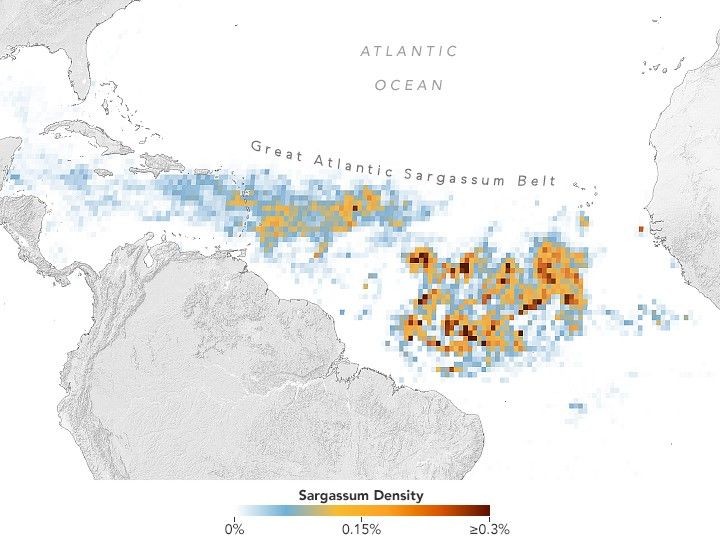
It begins as a deceptive embroidery upon the deep cobalt of the Atlantic, a shimmering, amber-hued carpet floating beneath the equatorial sun. But by June 2026, the Great Atlantic Sargassum Belt had swelled into something far more ominous: a sprawling, macroalgal empire of near-record proportions. According to data monitored by NASA’s orbital eyes, this gargantuan marine forest did not merely drift; it conquered, pushing biomass levels in both the Caribbean Sea and the Gulf of America to unprecedented, all-time highs. For those watching from the shorelines, the phenomenon is no longer a distant scientific curiosity. It has become a suffocating, sulfurous invasion—a tangible, rotting manifestation of a warming planet’s unruly and overstimulated fertility.
In the open ocean, Sargassum is a crucial sanctuary, a floating nursery that cradles everything from hatchling sea turtles to pelagic fish. Yet, when fed by the nutrient-rich runoff of the world’s great rivers and heated by soaring sea temperatures, this biological marvel mutates into a coastal curse. The luxury enclaves of the Mayan Riviera and the postcard-perfect bays of the Antilles now find their azure waters choked by a thick, rust-colored sludge. As the equatorial sun bakes the stranded weed, it decomposes into a toxic, hydrogen-sulfide-scented shroud. The resulting miasma does not merely drive tourists from the beaches; it suffocates coral reefs, starves seagrass meadows of light, and disrupts local artisanal fisheries with indifferent, devastating efficiency.
> "We are witnessing a seasonal rhythm mutated into a permanent crisis, where the oceans are throwing back at us the very excesses we have poured into them."
To observe this phenomenon from the cold, clinical distance of space is to appreciate the sheer, terrifying scale of the Anthropocene. NASA’s sensors capture a living bridge of weed stretching thousands of miles, linking West Africa to the Americas in a testament to global ecological interconnectedness. This June’s record-shattering peak serves as a grim harbinger of a new baseline, where seasonal inundations are no longer anomalies to be managed, but a permanent tax on the tropical lifestyle. As coastal municipalities deploy fleets of barriers and harvesters in a desperate, Sisyphean effort to reclaim their sands, the Great Sargassum Belt remains—a glittering, floating monument to a biosphere thrown violently out of balance, and a golden tide that refuses to be ignored.