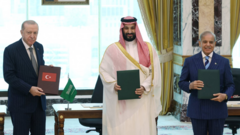
The New Crescent: Riyadh, Ankara, and Islamabad Redraw the Geopolitical Map
In an era defined by the rapid fragmentation of post-Cold War security architectures, the announcement of a tripartite defense pact between Saudi Arabia, Turkey, and Pakistan carries the heavy, unmistakable weight of a historical pivot. The core of the agreement—articulated by Islamabad with a stark, NATO-style clarity—is that an attack on any one of these sovereign nations will be treated as an attack on them all. Set against the backdrop of a Middle East currently convulsed by escalatory violence and shifting loyalties, this alliance is far more than a mere bureaucratic signature. It is a calculated, high-stakes realignment of military and political gravity across the Islamic world, signaling the birth of a formidable security entente designed to operate independently of traditional Western spheres of influence.
To map this new strategic triangle is to witness a symbiotic fusion of distinct, formidable national assets. Riyadh brings the immense gravity of its sovereign wealth and its custody of Islam’s holiest sites, stepping firmly out from under the umbrella of American security dependency to act as a sovereign patron of regional stability. Ankara offers the kinetic prowess of a battle-tested NATO military power, bolstered by a domestic defense industry that has turned its high-tech drones and naval corvettes into highly sought-after global currency. Islamabad, meanwhile, contributes the ultimate equalizer: a massive, highly disciplined standing army and the Islamic world’s only nuclear arsenal. Together, this triad bridges the Gulf, the Levant, and South Asia, creating a contiguous corridor of deterrence that challenges both regional adversaries and distant superpowers.
> "This tripartite pact represents a post-American reality in the Global South, where middle powers no longer wait for Western guarantees to draft their own scripts of survival."
By invoking a "one-for-all" collective defense doctrine, these three capitals are signaling a profound impatience with the existing international order. For decades, Washington managed its relationships with Riyadh, Ankara, and Islamabad in discrete, transactional silos. This newly minted alliance effectively demolishes those silos, presenting a unified front that will force a major recalibration in Western capitals, as well as in Moscow and Beijing. As the traditional security guarantees of the late twentieth century continue to erode under the strain of proxy wars and economic nationalism, this pact suggests that the future of regional stability will not be written by global hegemons, but by those who are willing to leverage their own sovereignty to defend it.