The Empty Tank and the Fluttering Flag: Inside Russia’s Summer of Dissonance
The Choreography of Scarcity
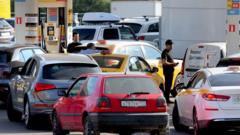
Under the heavy late-August sun, a peculiar choreography of modern Russian life is playing out along the arterial roads of the provinces and the outer rings of Moscow. As the Kremlin prepares to drape the nation in the triumphalist silks of Russian Flag Day, its citizens are idling in petrol queues that stretch not toward a glorious future, but toward dry pumps. It is a scene rich in Soviet-era resonance: the grandiosity of the state juxtaposed with the quiet, grinding scarcity of daily life. For eighteen months, the government has insisted that the "special military operation" remains a distant geopolitical abstraction—a rumble on the periphery that does not disturb the rhythm of domestic comfort. Yet, as fuel gauges hover near empty and lines of Ladas and imported sedans lengthen, the material reality of a war of attrition is finally seeping into the bedrock of the Russian everyday.
The Paradox of Plenty
The irony is as thick as the exhaust fumes hanging over the waiting motorcades. The world’s primary petrostate, a titan of global energy exports, is suddenly suffering from parched gas stations. This paradox is the child of necessity and violence: Ukrainian drone strikes have repeatedly punctured domestic refineries, while railway bottlenecks and Western sanctions have warped the internal logistics of distribution. Yet, where there is a deficit of petroleum, there is a manic surplus of state-sanctioned piety. Across public squares, municipal workers diligently hoist the white, blue, and red tricolor, transforming concrete plazas into canvases of forced optimism. Patriotism, in the modern Russian idiom, has been repurposed as a civic utility—the only commodity currently distributed with absolute abundance.
> "The state gives us flags because it cannot give us fuel."
This dry, fatalistic observation from a waiting motorist captures the prevailing mood: a resignation that has sustained Russians through centuries of imperial overreach.
The Art of Looking Away
```
[ Russian Domestic Fuel Strain: A Snapshot ]
├── Infrastructure: Refinery outages from targeted drone strikes
├── Logistics: Railway cargo prioritized for military supply chains
└── Psychology: High state-directed patriotism masking economic friction
```
To survive in contemporary Russia is to master the art of cognitive dissonance—holding a flag in one hand while nursing an empty tank with the other. State-run media outlets smoothly frame the fuel disruptions as minor technical anomalies, temporary hiccups on the road to inevitable victory. But the long queues represent a slow-burning friction. They are physical manifestations of the economic strains that the Kremlin’s accountants have tried to paper over with subsidized loans and statistical sleight-of-hand. In these queues, patriotism is rarely rejected outright; instead, it is weaponized as a coping mechanism. To complain about the petrol is to risk being labeled a defeatist; to endure the wait is to perform one’s patriotic duty.
As the sun dips below the horizon, casting long shadows across the concrete forecourts of regional filling stations, the flags continue to flutter, pristine and unbothered by the economic gravity below. The queues will eventually disperse, the tanks will be filled at exorbitant prices, and Flag Day will proceed with its choreographed splendor. But the ledger of Russian imperial ambition has always been written in the quiet sacrifices of its people—measured now not just in lives lost at the front, but in hours surrendered at the pump.