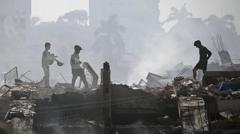
Rescuers Search Rubble for Survivors as Venezuela Earthquakes Kill at Least 235
CARACAS, Venezuela — Emergency crews and volunteers are racing against time to pull survivors from the debris after two powerful, shallow earthquakes struck northern Venezuela in rapid succession. According to local disaster management authorities, the catastrophic seismic event has claimed the lives of at least 235 people and left more than 4,300 others injured. The dual tremors, both measuring above magnitude 7.0, struck just seconds apart, catching residents unprepared and causing widespread structural collapses across several northern provinces and coastal cities.
The back-to-back quakes, which seismologists described as a rare "doublet" event, occurred at a shallow depth of less than 10 kilometers. This shallow origin intensified the ground motion, tearing through residential neighborhoods, severing power lines, and fracturing major transit routes. "The first tremor shook the foundations, and before people could escape their homes, the second hit, bringing entire concrete structures down," said Carlos Pérez, an emergency coordinator operating in the hard-hit coastal state of Sucre. "Our current focus is entirely on finding signs of life beneath the ruins, but the threat of severe aftershocks is making the rescue efforts incredibly hazardous."
Venezuela's northern coast lies along the complex boundary between the Caribbean and South American tectonic plates, a zone long recognized for its seismic hazard. Geologists point to the active Boconó and San Sebastián fault systems as the primary drivers of these violent shifts. Historically, the country has suffered devastating losses from earthquakes, most notably the 1967 Caracas earthquake and the 1997 Cariaco disaster. However, experts note that the sheer energy released by two consecutive magnitude 7-plus events in such a tight timeframe represents an unprecedented challenge for the nation’s infrastructure.
As hospitals in the affected areas struggle to cope with the influx of over 4,300 injured citizens, the Venezuelan government has declared a state of emergency in the most impacted regions. Temporary medical tents are being erected in public parks to triage victims, while humanitarian agencies warn of a looming crisis regarding clean water, food, and medical supplies. International aid groups are currently mobilizing emergency response teams, though damaged roads and power outages are expected to slow the arrival of heavy search-and-rescue equipment to isolated mountain communities.