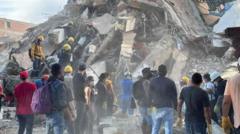
The Trembling Earth: Inside the Desperate Search for Survivors in Colombia
The earth in Colombia does not settle; it trembles with a predatory patience. On Tuesday, a series of violent aftershocks shuddered through the fractured Andean landscape, a cruel postscript to an earthquake that has already claimed at least 180 lives. Across afflicted towns and municipal centers, the air remains thick with the chalky, pulverized ghost of concrete and plaster—the physical remains of domesticity suddenly transformed into tombs. For those navigating the debris, the disaster is not a past-tense event but a continuous, unstable present, where every creaking beam and sudden shift of gravel serves as a visceral reminder of human fragility against the immense, indifferent machinery of tectonic drift.
Amidst this fragile topography, a desperate choreography of survival is unfolding. Rescuers—their faces masked against the rising dust, their hands raw from clawing through fractured brick—work in a race against both the clock and the shifting earth. Every recovery effort is a tense negotiation with gravity, where the thunderous roar of heavy machinery must periodically yield to a sudden, agonizing silence. In those quiet intervals, volunteers and professional search-and-rescue teams press their ears to the narrow gaps in collapsed ceilings, straining to catch the faint, percussive tapping of those still trapped in the subterranean dark. It is a grueling test of human endurance, fueled by a collective refusal to let the mounting death toll swallow the possibility of miraculous preservation.
> "Every recovery effort is a tense negotiation with gravity, where the sound of heavy machinery must periodically yield to a sudden, agonizing silence."
Yet, as the immediate panic crystallizes into grief, the tragedy inevitably reveals the deeper, systemic fault lines that define the region. Disasters of this scale are rarely purely natural; they are architectural and socioeconomic indictments. In the precarious barrios clinging to steep hillsides and the rapidly constructed urban corridors, the collapse of these structures exposes the historic gap between rapid municipal growth and stringent seismic safeguards. The rubble is a quiet testament to a vulnerability that is as much political as it is geological, leaving the country’s most marginalized populations to bear the disproportionate weight of the earth’s upheaval as they begin the long, agonizing vigil for the missing.