The Panoptic Porch: Randy Fine and the Sunday Afternoon Transgression
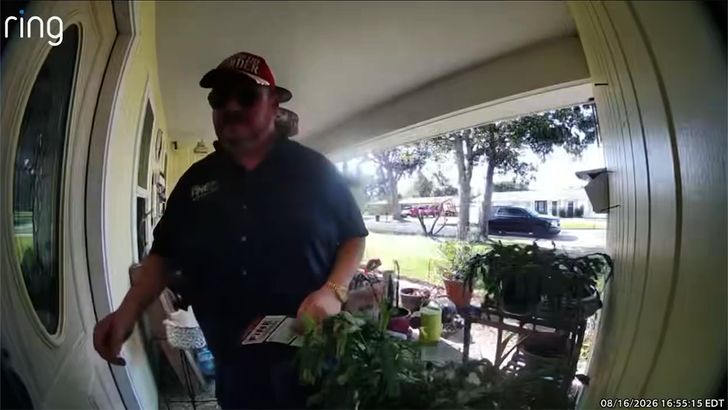
In the twilight hours of an American election cycle, the suburban porch becomes a high-stakes theater of performative humility. For Florida lawmaker Randy Fine, a combative and polarizing fixture of the state’s conservative establishment, the stage was a quiet neighborhood walkway just hours before a crucial Republican primary. Yet, what was designed as a routine exercise in the fading, tactile art of retail campaigning instead dissolved into a quiet comedy of boundary-crossing, captured in the unblinking, high-definition gaze of a doorstep panopticon. At precisely 4:55 PM on a sticky Sunday afternoon, a homeowner’s Ring camera recorded Fine not merely seeking votes, but transgressing one of the few remaining sacrosanct boundaries of domestic privacy: the family mailbox.
The footage, which quickly circulated with the viral velocity characteristic of modern political embarrassments, depicts Fine clad in the casual uniform of the weekend canvasser. But the narrative takes a bizarre, almost novelistic turn when the lawmaker’s focus shifts from the doorbell to the metal receptacle mounted nearby. With a casualness that suggests either a profound sense of entitlement or a sudden lapse in situational awareness, Fine is seen lifting the lid, peering inside, and rifling through the homeowner’s correspondence. It is a striking visual metaphor for the modern political apparatus—an elite class so desperate to gauge the public pulse that they are willing to physically pry into the quiet, mundane remnants of daily life. Whether he was searching for a rival's literature or merely acting on an undisciplined impulse, the image of a sitting lawmaker violating federal postal boundaries in broad daylight serves as an exquisite portrait of campaigning stripped of its polite veneer.
```
"The very surveillance apparatus that suburban voters install to keep the world at bay has turned its lens inward, catching a political operator in a moment of clumsy curiosity."
```
In an era where personal privacy is a currency we routinely surrender to Silicon Valley, the mailbox has long stood as an archaic fortress, protected by federal statute and a tacit social contract. Fine's brief, physical excursion into a constituent’s mail highlights a deeper, more unsettling reality of contemporary political life: the absolute erosion of the barrier between the public servant and the private citizen. For Fine, a politician who has built a brand on sharp-elbowed rhetoric and aggressive legislative maneuvering, this digital exposure is a humbling reminder of the modern landscape. The very surveillance apparatus that suburban voters install to keep the world at bay has turned its lens inward, catching a seasoned political operator in a moment of undisciplined, low-stakes opportunism.
Ultimately, the incident is less a grand conspiracy than a tragicomic vignette of primary-season desperation. It underscores the frantic, sweaty final hours of a campaign where every threshold must be crossed, and apparently, every lid lifted. As voters headed to the polls, the image of Fine lingering at the mailbox remained—a quiet testament to the fact that in the theater of modern democracy, the most damaging revelations are rarely the grand scandals of statecraft, but rather the small, unscripted moments of human overreach captured in the cold, digital light of a Sunday afternoon.