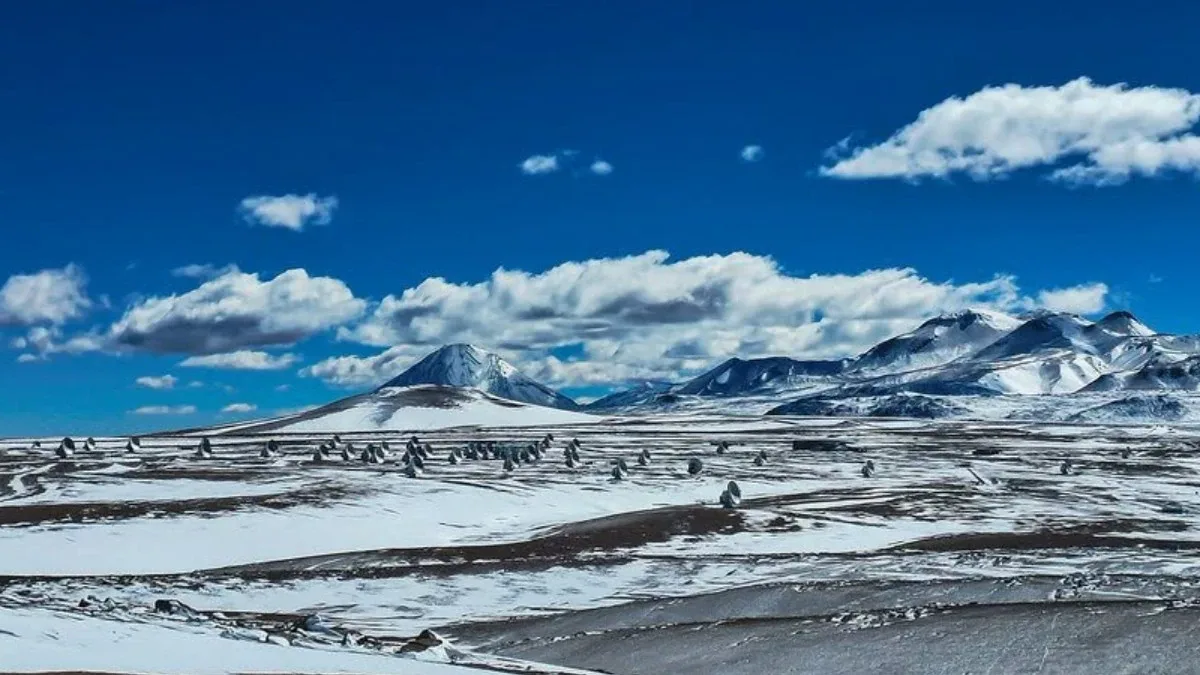
The White Silence of the Atacama: An Uncanny Winter in the Earth’s Driest Dust
The Atacama Desert has long existed as a monument to geological permanence—a vast, rust-colored expanse so sterile and hyper-arid that space agencies routinely use its cracked basins to simulate the dead soil of Mars. It is a landscape defined by the absolute absence of water, where rain is not a seasonal expectation but a generational myth. Yet, in late August 2026, this grand monument to drought underwent a surreal, monochromatic transfiguration. A pair of potent, back-to-back winter storms swept across northern Chile, defying the region's ancient dryness and draping a silent, heavy blanket of snow from the jagged crests of the high Andes down to the coastal terraces kissing the Pacific Ocean.
From orbit, NASA’s earth-observing satellites captured a vista that felt less like terrestrial geography and more like a fever dream of planetary recalibration. A stark, glittering white shroud covered the salt flats of the Llano de la Paciencia, muting the desert’s violent ochres and deep copper tones. For climatologists and local observers alike, the event was a mesmerizing but disquieting spectacle—a vivid manifestation of the atmosphere’s increasingly mercurial moods. To see one of the driest places on Earth buried beneath several inches of frozen moisture is to witness a profound ecological irony, a sudden rewriting of the aesthetic and physical laws of a territory accustomed only to the relentless glare of the sun.
As the storms cleared, they left behind a fleeting, fragile world of sharp contrasts. Columnar cacti, evolutionarily sculpted to subsist on nothing more than the ghostly ocean fogs known as camanchaca, stood like frozen sentinels beneath heavy caps of powder, while the red-clay canyons bled crimson against the melting drifts. This brief, luminous subversion of the Atacama’s identity serves as a potent metaphor for our contemporary ecological moment. It is a reminder that in an era of shifting global dynamics, even the most immutable sanctuaries of heat and dust can be silenced, if only for a few breathtaking days, by the sudden, crystalline weight of winter.