Shadows on the Red Planet: The Solitary Theater of Perseverance
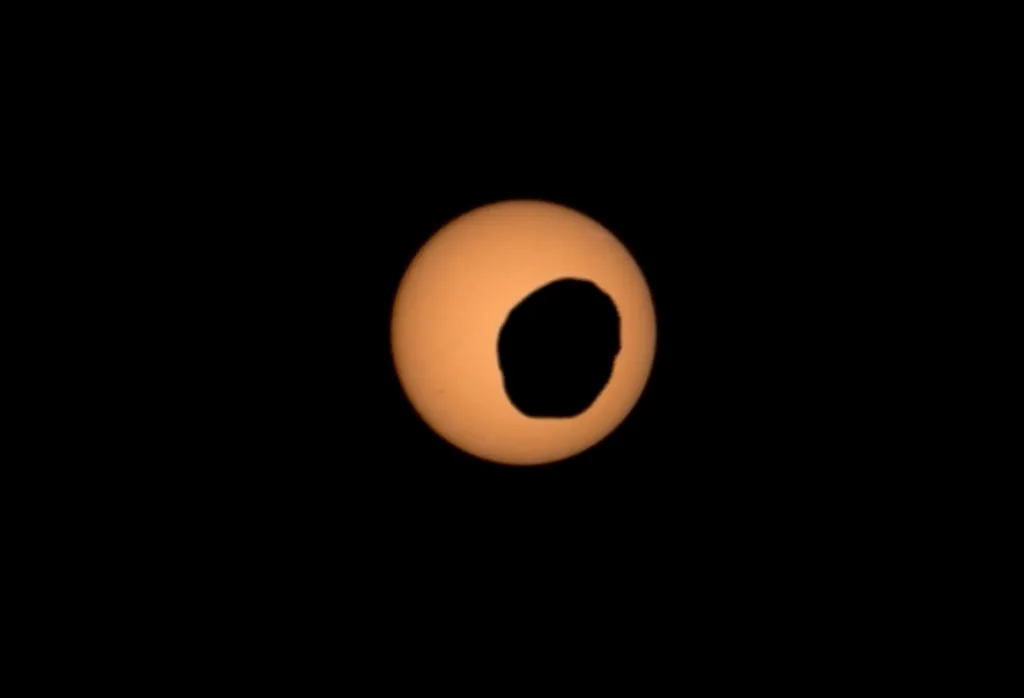
On the wind-scoured expanses of Jezero Crater, where time is measured not by the rustle of autumn leaves but by the cold, mechanical progression of Martian sols, a solitary explorer paused its labor to look at the sky. On August 12, 2026—marking Sol 1,948 of its tenure—NASA’s Perseverance rover swiveled its sophisticated Mastcam-Z camera upward. What it captured is a brief, hauntingly elegant piece of cosmic theater: the silhouette of Phobos, the larger of Mars’s two moons, traversing the brilliant face of the Sun. In the desolate quiet of the Red Planet, this celestial transit unfolds not as the grand, terrestrial spectacle of a total eclipse, but as an intimate, starkly silhouetted dance of light and shadow, captured by a machine acting as humanity’s proxy eye.
Phobos itself possesses none of the luminous, pearl-like majesty of Earth’s moon. It is a battered, potato-shaped fragment of primordial rock, heavily cratered and structurally fragile, locked in a slow-motion death spiral around its parent planet. As it crossed the solar disk, it appeared not as a perfect circle, but as a jagged, dark handprint passing over a distant lantern. This irregular silhouette is a testament to the raw, unpolished mechanics of our solar system. It is a reminder of Phobos’s ultimate destiny: in some tens of millions of years, gravitational tides will pull the moon past its breaking point, tearing it apart into a dusty Martian ring or sending its fragments crashing into the very rust-colored soil over which Perseverance now roves.
> "By adjusting the stark, binary reality of a silicon sensor to match our own sensory limitations, the imagery bridges an immense existential gulf."
What elevates this technical observation into a work of profound aesthetic resonance is a delicate touch of human curation. The raw data captured by the Mastcam-Z was deliberately color-graded, tinted to simulate the warm, dusty orange hue that a human observer would witness if they were standing on the Martian surface, squinting through the visor of a space suit. This chromatic translation is more than a scientific convenience; it is an act of imaginative empathy. By adjusting the stark, binary reality of a silicon sensor to match our own biological limitations, NASA’s engineers have bridged an immense existential gulf, allowing us to temporarily inhabit a world we have yet to walk.
Ultimately, the imagery of the Phobos transit is a poignant artifact of our current technological epoch. We remain a species of dreamers marooned on a warm blue world, sending metallic sentinels into the freezing dark to report back on the state of the cosmos. In the frame-by-frame stutter of Phobos blocking the sun, we see both our profound isolation and our stubborn refusal to accept it. Perseverance’s gaze is, in the end, our own: a restless search for meaning written in the dust of distant spheres, finding a fleeting, melancholy beauty in the shadow of a doomed moon.