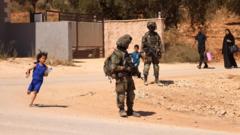
The Architecture of Displacement: How the Domestic Front in Qusra Became a Garrison
In the undulating hills of the northern West Bank, the village of Qusra has long existed in the crosshairs of a creeping, territorial friction. Here, where the ancient silver of olive groves meets the sterile, razor-wire geometry of encroaching ideological settlements, the concept of home has ceased to be a sanctuary. It has instead become a tactical coordinate. According to the village’s mayor, the Israeli military has begun systematically ordering Palestinian families to vacate their ancestral residences, converting private kitchens and bedrooms into makeshift barracks. The transition is both swift and devastatingly quiet: a knock on a heavy wooden door, a curt command delivered in Hebrew and broken Arabic, and the domestic clutter of family life is abruptly supplanted by the cold iron of military gear, communications arrays, and the muddy boots of young conscripts.
This latest wave of displacement does not occur in a vacuum; it is the grim sequel to an escalatory siege by Israeli settlers, whose aggressive maneuvers have increasingly dictated the rhythm of survival in Qusra. In the West Bank's fragmented geography, the distinction between state military action and vigilante settler expansion has long since blurred into a singular, cohesive pressure. When ideological zealots surround a village, the subsequent arrival of the army rarely signals rescue for the besieged Palestinians; instead, as the local leadership’s reports suggest, it heralds a formalized usurpation. The requisitioning of homes as military outposts serves a dual purpose: it pacifies the immediate landscape to secure the settlers' flank while quietly, inexorably, shrinking the boundaries of Palestinian daily existence.
There is a profound, almost gothic indignity to this form of occupation. To have one’s dining table transformed into a planning desk for patrols, or one’s children’s bedrooms repurposed as barracks, is to experience the utter erasure of privacy and sovereignty. It is a psychological siege that weaponizes the very architecture of intimacy. For the families forced onto the dusty perimeter of their own lives, looking back at the glowing windows of their seized homes, the loss is not merely physical but symbolic. It is a stark, unyielding demonstration of power, illustrating that in the eyes of the occupying apparatus, their presence is not a permanent reality to be respected, but a logistical inconvenience to be managed, cleared, and militarized.