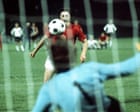
The Sublime Hubris of the Chip: Fifty Years of the Panenka
The penalty kick is football’s ultimate melodrama, a binary crisis of nerves boiled down to twelve yards of white chalk and a fraction of a second. Yet, fifty years ago in Belgrade, a mustache-twirling Czechoslovakian midfielder named Antonín Panenka looked into the yawning abyss of a European Championship final shootout and chose not violence, but theater. His delicate, gravity-defying chip over a sprawling Sepp Maier did more than secure a trophy for Czechoslovakia; it introduced a radical aesthetic of insolence to the global game. To attempt a Panenka is to perform an existential high-wire act. If it succeeds, the kicker is hailed as a visionary genius who has momentarily conquered the psychological terror of the sport; if it fails—drifting harmlessly into the waiting chest of an unmoved goalkeeper—it becomes a public execution of the taker's dignity, a monument to unearned hubris.
> "To chip a goalkeeper in the high-stakes theater of a penalty shootout is not merely to score; it is to temporarily suspend the laws of physics and the dictates of common sense in favor of pure, insolent art."
For decades, this singular act of bravado remained a localized, almost mythic curiosity, largely buried in the analog archives of the Cold War. A search of contemporary news print reveals that for nearly a quarter of a century, the phrase "Panenka" was barely uttered in the lexicon of Western sport. It required the dawn of the internet generation and the effortless, Roman arrogance of Francesco Totti at Euro 2000 to resurrect the maneuver for the modern era. When Totti chipped Edwin van der Sar in Amsterdam, he did not just convert a penalty; he digitized Panenka's legacy, transforming a historical footnote into a viral meme of supreme self-confidence. By the time Andrea Pirlo humiliated Joe Hart in 2012, and Zinedine Zidane chipped Gianluigi Buffon in the 2006 World Cup Final, the noun had firmly solidified into a verb.
Now, standing in 2026 on the golden jubilee of its inception, the Panenka occupies a sacred, if precarious, place in the sport's cultural tapestry. In an era dominated by relentless data metrics, hyper-athletic goalkeepers who stand their ground, and the panopticon of video assistant refereeing, the chip represents a dying gasp of pure, unquantifiable human drama. It is a gesture that refuses to be optimized by an algorithm. Whether executed with the chilling precision of Alexis Sánchez to win the Copa América, or botched with the tragicomic bathos of a failed Sunday league attempt, the Panenka remains the ultimate litmus test of a footballer's soul—a brief, beautiful moment where sport transcends athletic utility and flirts with the sublime.