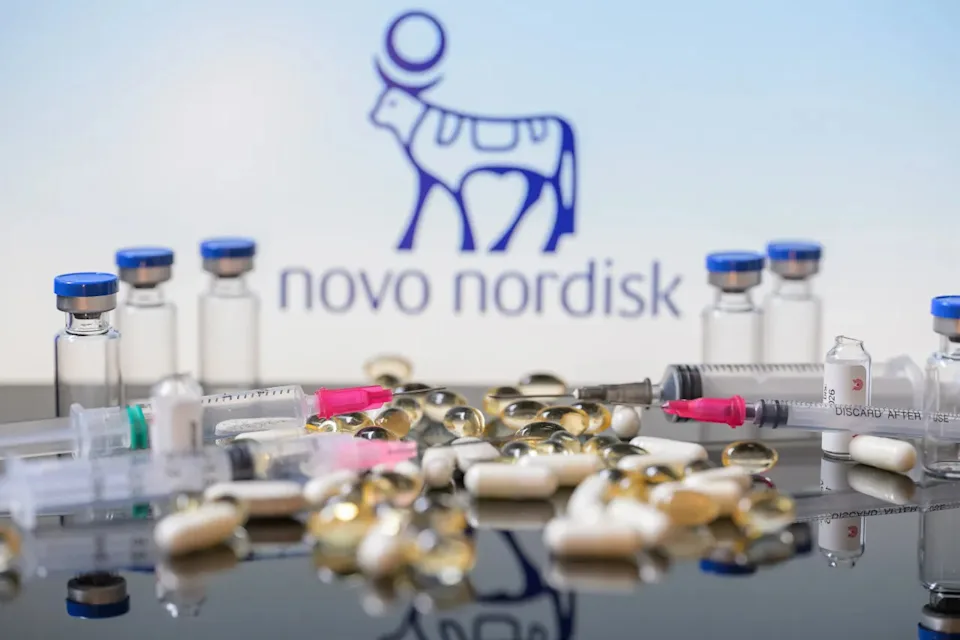
The Weight of Expectation: Novo Nordisk and the Perils of the GLP-1 Gilded Age
In the gilded arena of modern pharmaceuticals, there is perhaps no greater curse than becoming the architect of your own impossible standard. For Novo Nordisk, the Danish juggernaut that overnight transformed both the global waistline and its home nation’s economic ledger with its blockbusters Ozempic and Wegovy, a reckoning with this reality arrived on trading desks this week. Despite raising its full-year sales and profit outlook—a feat that would inspire champagne toasts in almost any other sector—the Copenhagen-based titan watched its shares slide. It was a stark reminder that in the hyper-leveraged, highly emotional theater of the GLP-1 gold rush, merely spectacular performance is increasingly coded as a disappointment. Wall Street, having tasted the intoxicating draft of exponential growth, now views any hint of operational friction not as a temporary bottleneck, but as a loss of momentum.
The Battle for the Global Waistline
At the heart of this market caprice lies a fiercely contested duopoly. Novo Nordisk is no longer whispering into an empty room; Indianapolis-based Eli Lilly has marched into the territory with its rival treatments, Mounjaro and Zepbound, armed with aggressive manufacturing expansions and formidable clinical efficacy data. The battle is no longer merely one of laboratory ingenuity, but of raw industrial muscle. For Novo, the challenge of scaling up production to meet a seemingly bottomless well of global demand has become a Sisyphean endeavor. The sterile filling lines and complex supply chains required to produce pre-filled injector pens have become the ultimate choke points. In this race, any sign that Novo is stumbling in its manufacturing sprint is eagerly seized upon by an impatient investor class, which increasingly looks to Lilly as the nimbler, more aggressively capitalized colossus.
> "The challenge is no longer convincing the world that these drugs work; it is physically pouring them into vials fast enough to satisfy human desire."
The Material Reality of a Speculative Boom
The numbers themselves tell a story of an empire hitting the boundaries of its physical architecture. Novo adjusted its sales growth outlook upward to a glittering 22% to 28% for the year, yet narrowed its operating profit guidance, reflecting the immense capital expenditure required to buy, build, and retrofit factories worldwide. It is a classic corporate paradox: spending fortunes today to secure market share tomorrow, while a fickle market demands immediate, unblemished margins. To an investing public accustomed to the weightless, asset-light ascents of Silicon Valley tech monopolies, the capital-intensive reality of biological manufacturing is a cold shower. The financial markets are reacting to the friction of physical reality—the realization that curing obesity on a global scale requires actual brick, mortar, glass, and steel, none of which can be conjured with the ease of software code.
Ultimately, Novo Nordisk finds itself caught in a cultural and fiscal loop of its own making. Having successfully commodified the human desire for self-transformation, the company is now judged by the very ethos of the culture it helped create: an impatience with limitation, a demand for immediate results, and a deep-seated anxiety about falling behind. As Novo fights to maintain its vanguard position against a surging Eli Lilly, its slipping stock price serves as a poignant parable of our times. In the modern marketplace, as in the human body, the hardest thing to manage is never the hunger itself—it is the insatiable expectation of what comes next.