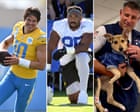
August in the National Football League is a strange, purgatorial theater. The dust of Canton’s Hall of Fame game has barely settled, yet the transition from late-summer exhibition to the cold, transactional reality of the regular season is already underway. For the reigning champion Seattle Seahawks, the warmth of their February triumph is rapidly cooling into the chill of expectation. To join the rarefied air of back-to-back champions—a feat achieved by only nine franchises in the modern era—is to fight not just thirty-one other hungry rosters, but the insidious gravity of complacency and the brutal math of the salary cap. Yet, unlike so many predecessors whose rosters were hollowed out by free agency and coaching raids, Seattle enters this campaign remarkably intact, a defensive monolith still humming with the violent, youthful arrogance that defined their ascendancy.
Elsewhere, the narrative landscape shifts to the calculated grandeur of the Rams, a franchise operating under the heavy, glittering crown of projected inevitability. In the modern NFL, hype is both currency and cudgel, and no team carries its weight with quite the same cinematic ambition. Their preseason is not merely a tune-up but a dress rehearsal for an empire, a showcase of tactical sophistication and roster-building bravado designed to feel less like a competitive endeavor and more like a mathematical certainty. Yet, inevitability in football is a fragile construct, easily shattered by an errant turf toe or a blown coverage. The Rams’ challenge in the coming weeks is to translate this aesthetic perfection from the pristine laboratory of the training camp into the muddy, unpredictable crucible of Sunday afternoons.
> "In the NFL, controversy is rarely a distraction; it is a catalyst, a grimly efficient fuel that powers a machine designed to thrive in the dark."
If the Rams represent the glossy future, the New England Patriots remain the league’s ultimate gothic drama, perpetually hovering between clinical excellence and existential crisis. As they navigate the latest storm of scandal—a familiar, almost ritualistic state of siege for the Foxborough faithful—one wonders not just if they will survive, but how they will once again weaponize the collective opprobrium of the sporting public. Under the hooded, inscrutable gaze of their leadership, the Patriots have long mastered the art of turning institutional friction into competitive fire. While the rest of the league dissects their transgressions, New England quietly constructs its counter-narrative, reminding us that on the gridiron, salvation is never found in public penance, but in the ruthless, silent accumulation of victories.