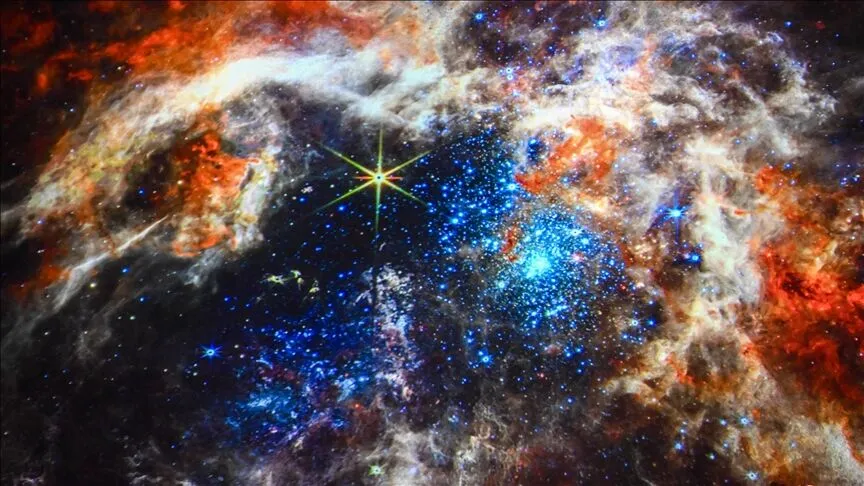
Webb Telescope Unveils Hidden Stellar Nurseries in Spectacular New Image of FS Tau
GREENBELT, Md. — NASA’s James Webb Space Telescope has delivered another breathtaking view of the deep universe, capturing the intricate, dusty cradle of the FS Tau star system in unprecedented detail. Utilizing its advanced infrared instruments, the observatory pierced through dense shrouds of interstellar gas and dust that had previously shielded these newborn stars from human sight. The resulting image showcases not only the sparking of stellar life within our own galaxy but also a dazzling backdrop teeming with thousands of distant, glittering galaxies, drawing comparisons to a brilliant fireworks display.
Located roughly 450 light-years away in the Taurus-Auriga star-forming region, the FS Tau system is a relatively young stellar nursery. It consists of a multi-star system containing protostars—stars in their earliest stages of development—surrounded by protoplanetary disks of gas and dust. Previous observations by optical instruments, including the Hubble Space Telescope, were severely limited by the opaque dust lanes blocking visible light. By utilizing Webb’s Near-Infrared Camera (NIRCam), astronomers can now trace the high-energy jets of matter ejected by these young stars and analyze the faint, warm glow of the circumstellar material that may eventually coalesce into planets.
A New Window into Stellar Origins
The newly released data reveals a complex environment of cosmic outflows and stellar feedback. As these young stars gather mass from their surroundings, they eject powerful streams of gas perpendicular to their disks. Webb’s infrared sensitivity allows scientists to map these energetic structures with exceptional clarity.
- Protostellar Jets: High-velocity streams of gas carving cavities through the molecular cloud.
- Protoplanetary Disks: Dense rings of dust and gas orbiting the newborn stars, serving as the building blocks for future planetary systems.
- Background Deep Field: Thousands of ancient, distant galaxies acting as a natural cosmic backdrop, aiding cosmologists in studying early universe structures.
"Webb continues to redefine our understanding of these stellar birthplaces," said Dr. Sarah Kendrick, an astrophysicist specializing in star formation. "By observing in the infrared, we aren't just seeing static structures; we are witnessing the highly dynamic, physical processes of accretion and feedback that govern how stars and solar systems form. It is like looking at the very blueprint of our own solar system's past."
Beyond the primary target of FS Tau, the deep-field background of the image is populated by a dense tapestry of ancient galaxies. These distant stellar islands, some dating back billions of years, appear as multicolored sparks across the cosmic canvas. This latest release underscores the paradigm-shifting capabilities of the $10 billion space observatory. As Webb continues its science operations, images like that of FS Tau serve a dual purpose: they fuel cutting-edge astrophysical research while capturing the public's imagination, peeling back the dusty veils of the cosmos to reveal the origins of stellar life.