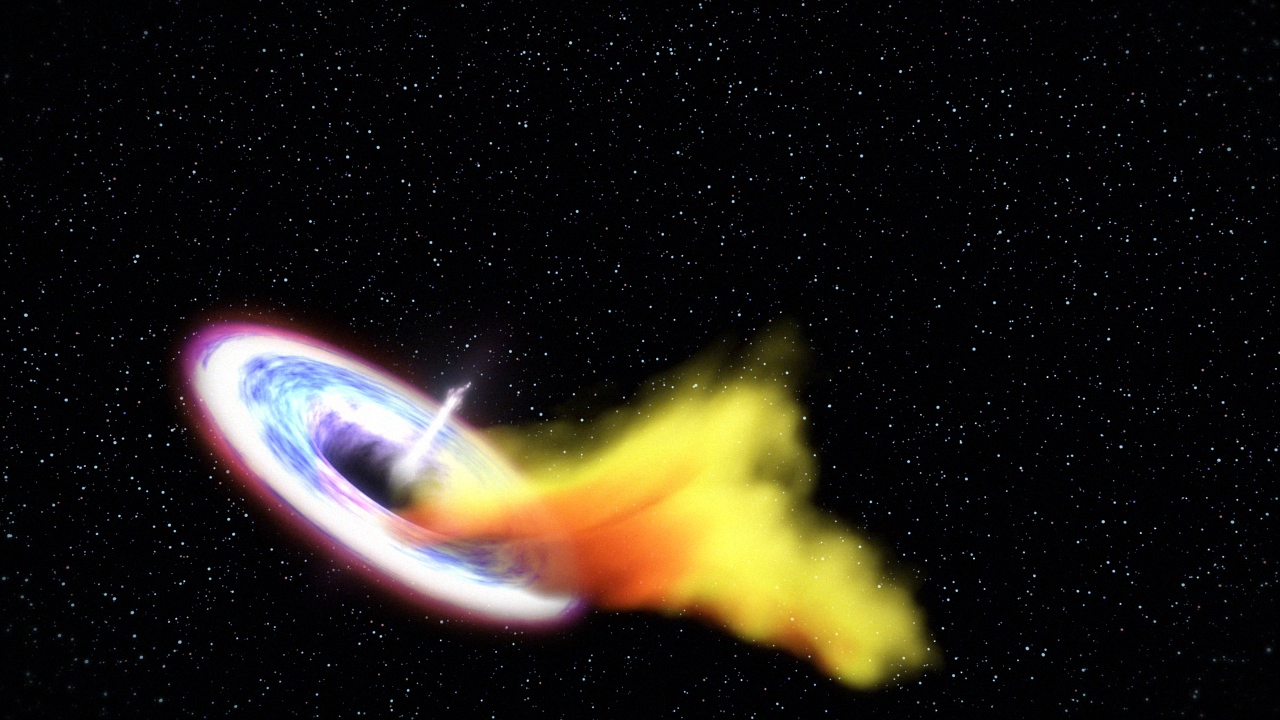
NASA's Swift Observatory Detects 'Wandering' Supermassive Black Hole Devouring a Star
In a groundbreaking astronomical observation, NASA’s Neil Gehrels Swift Observatory has detected an "orphan" supermassive black hole actively shredding a star on the distant outskirts of a faraway galaxy. This violent phenomenon, known as a tidal disruption event (TDE), occurs when a star wanders too close to a black hole's gravitational field and is ripped apart by immense tidal forces. While astronomers have documented TDEs before, they are almost exclusively observed within the dense cores of galaxies, where supermassive black holes typically reside. This marks the first time such an event has been captured so far from a host galaxy’s center, confirming the existence of wandering "mega" black holes in galactic suburbs.
The discovery provides crucial evidence for a long-theorized astronomical concept: wandering black holes. Astrophysicists suggest that these rogue giants can be cast out to the fringes of their host galaxies during galactic mergers. When two galaxies collide, their central black holes can form a binary system before eventually merging. During this violent process, the emission of asymmetric gravitational waves can exert a recoil force, kicking the newly merged black hole entirely out of the galactic nucleus to wander through interstellar space. Alternatively, the wandering black hole may have belonged to a smaller dwarf galaxy that was gravitationally stripped and consumed by a larger one, leaving its central engine stranded in the outskirts.
Because inactive black holes emit no light of their own, they remain virtually invisible against the dark backdrop of space until they feed. The Neil Gehrels Swift Observatory, which monitors the cosmos for transient high-energy events in X-ray, ultraviolet, and optical wavelengths, captured the sudden, bright flare of radiation emitted as the doomed star's matter was pulled into an accretion disk.
"We were looking for these star-shredding events as a way to locate these otherwise invisible, wandering black holes," noted researchers analyzing the Swift data. "Seeing one light up so far from its galaxy's core is a major breakthrough, proving that these rogue giants are out there and providing us with a new method to track them down."
This discovery opens a new frontier in high-energy astrophysics, demonstrating that the outer halos of galaxies may host massive, hidden objects. Astronomers plan to utilize the Swift observatory alongside upcoming next-generation wide-field telescopes to scan the outer halos of nearby galaxies for similar transient flares. By studying these outlying TDEs, scientists hope to calculate the abundance of wandering black holes and gain deeper insights into the complex history of galactic evolution and mergers across cosmic time.