The Crimson Ballet: How NASA’s ‘SkyFall’ Concept Rewrites the Rules of Martian Exploration
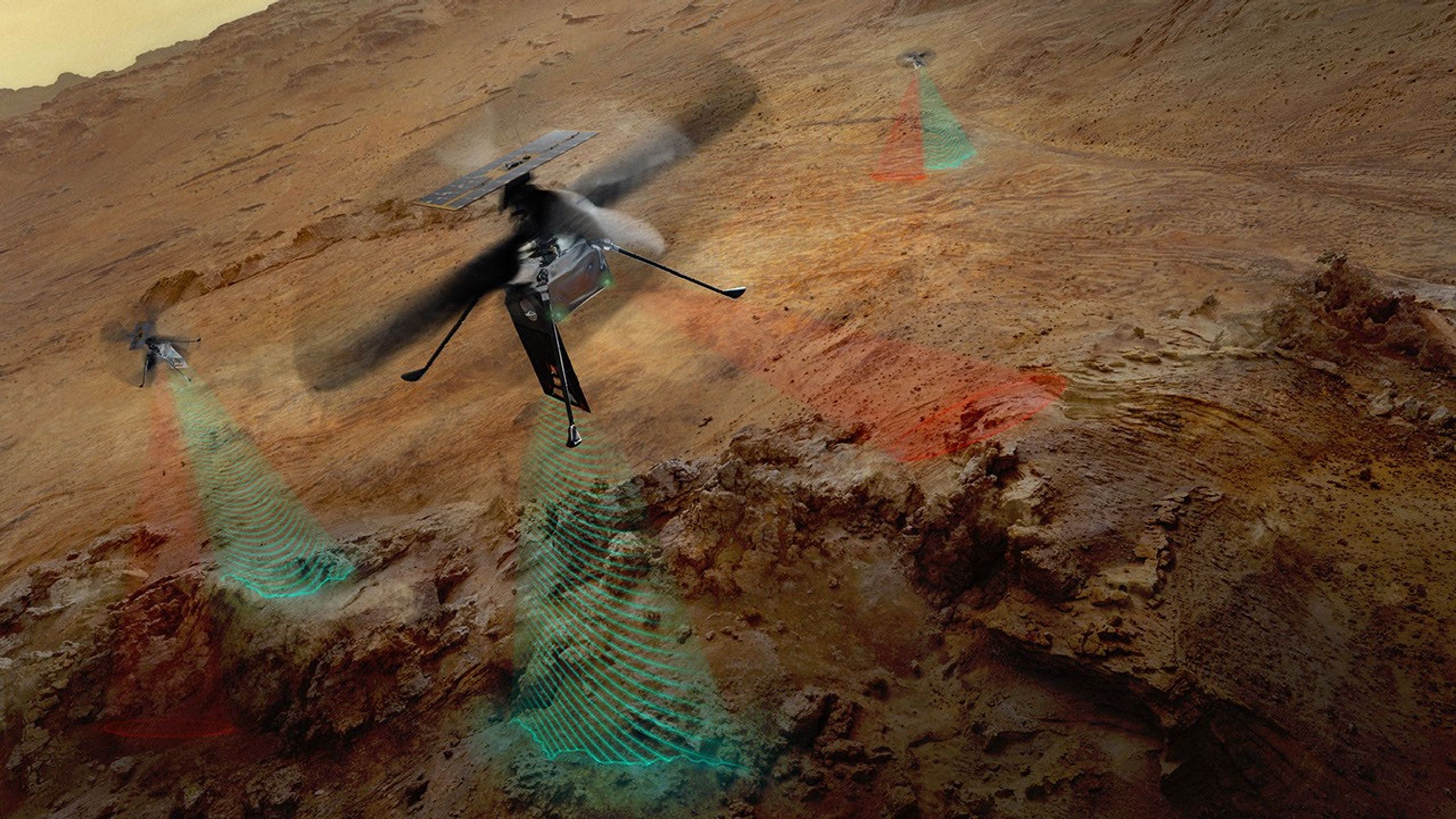
For decades, our relationship with Mars has been defined by a slow, agonizing crawl. We have treated the Red Planet as a terrestrial sandbox, sending heavy, wheeled emissaries to drag themselves across the ancient rust of the Meridiani Planum at a glacial pace. But the future of planetary exploration is discarding its ground-based anchors to claim the thin, frigid Martian sky. In a striking new conceptual rendering released by NASA, the space agency envisions an aerial triad known as the "SkyFall" helicopters. It is an image that represents a profound paradigm shift: a coordinated, three-dimensional ballet of light and soundless waves, transforming a dead world into an active laboratory.
```
▲
/ \ [SkyFall Rotorcraft]
/[___]\
/ | \ ◄─── Green Waves: Subsurface Radar
/ | \
/ | \ ◄─── Red Beams: Near-Infrared Regolith Imaging
```
The artwork depicts three nimble, arachnid-like rotorcraft hovering suspended over a desolate Martian canyon, carving up the planetary silence with invisible diagnostic instruments. Emanating from their disproportionately large antennas are sweeping green arcs—the graphic representation of subsurface radar penetrating deep into the planet's frozen crust. These green pulses whisper secrets of buried aquifers, ancient ice sheets, and the geological architecture hidden beneath millennia of dust. Intersecting these waves are sharp, crimson beams of near-infrared light, slicing downward to probe the regolith. This dual-spectral assault does more than capture imagery; it maps the chemical and mineralogical signatures of the crushed rock, searching for the molecular debris of a wetter, warmer past. It is cutting-edge science rendered as a high-contrast chiaroscuro against the eternal, ochre gloom of the Martian atmosphere.
This conceptual fleet represents a profound evolution in how humanity maps the cosmos. Where previous missions relied on solitary, risk-averse survivalists, the SkyFall concept champions a distributed, symbiotic intelligence. By taking to the air, these helicopters can bypass the treacherous cliffs, sand traps, and boulder fields that have historically menaced NASA’s rovers, accessing vertical canyon walls and crater depths once deemed unreachable. As these autonomous scouts peer beneath the soil and decode the surface, they are doing more than collecting raw data; they are drafting the literal and metaphorical cartography for the human expeditions that will inevitably follow. In the silent, elegant flight of the SkyFall triad, we are watching the first drafts of our interplanetary future being written in beams of red and green light.