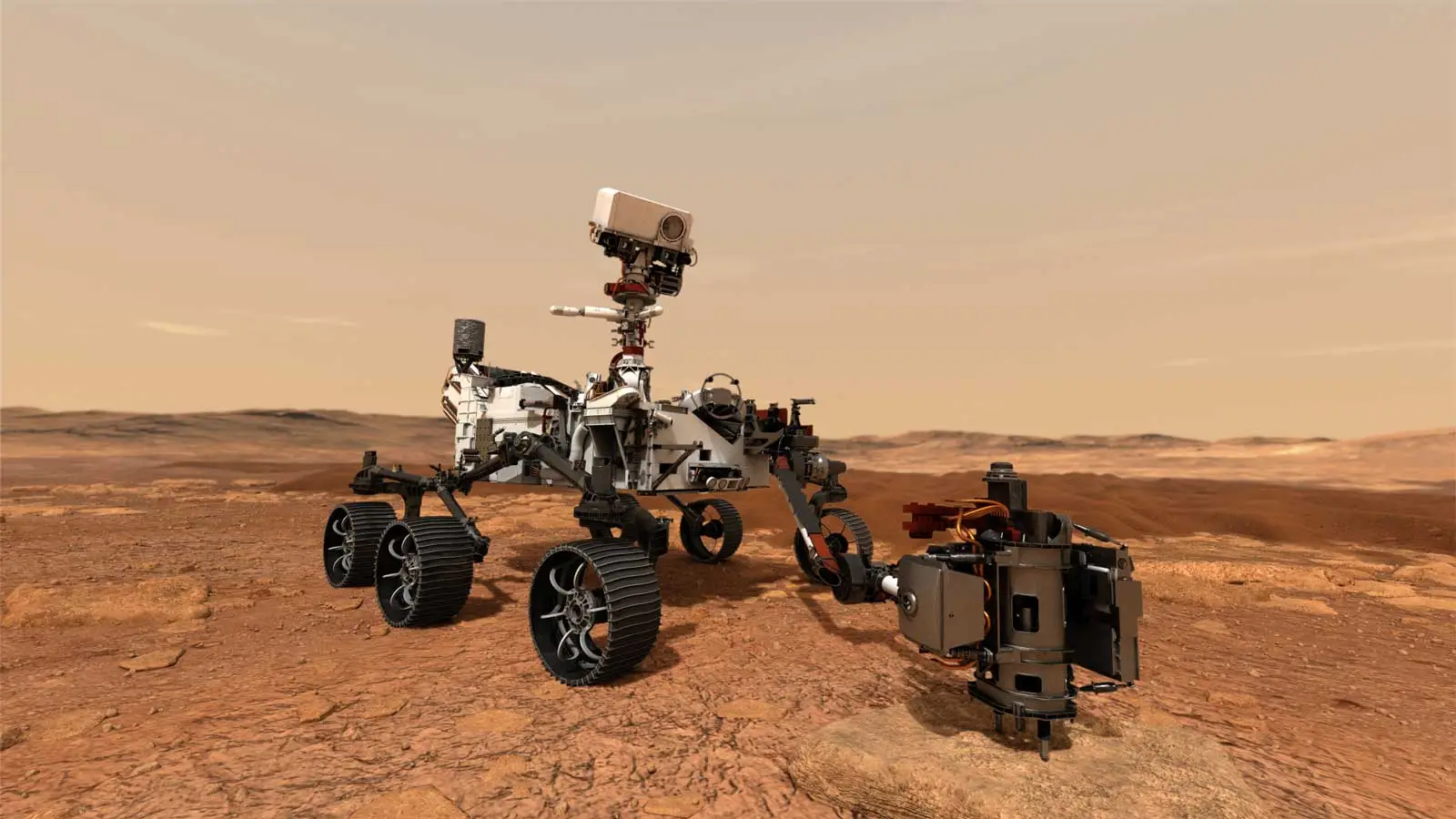
The Vanishing Point: Perseverance Captures Earth’s Silent Eclipse Behind a Martian Moon
In a haunting display of cosmic scale, NASA’s rover records our home planet disappearing behind the scarred silhouette of Phobos.
***
From the dry, wind-scoured floor of Jezero Crater, humanity’s most sophisticated robotic emissary recently paused its geological scrawling to look back at the womb that bore it. In a sequence of images captured by NASA’s Perseverance rover, our home planet is reduced to a solitary, fragile spark of light hanging in the bruised Martian twilight, only to be slowly extinguished by the encroaching crescent of Phobos. It is the first time in the history of space exploration that this specific celestial occultation—the vanishing of Earth behind a Martian moon—has been witnessed and recorded from the surface of another world. The resulting footage is not merely a technical triumph of robotic optics; it is a haunting piece of cinema, a silent ballet choreographed across millions of miles of empty space that underscores our profound isolation in the dark.
There is a sharp, poetic irony in the actors of this cosmic drama. Phobos, a lumpy, potato-shaped fragment of space debris named for the ancient Greek god of panic, is a doomed celestial body, gradually spiraling inward toward an eventual, catastrophic breakup against the Martian atmosphere millions of years from now. Yet in this brief transit, it plays the giant, its dark silhouette blotting out the entire cradle of human history in a slow-motion eclipse. Earth, by contrast, is stripped of its geographic vanity, its roaring oceans, and its geopolitical fractures, compressed instead into a single photon of blue-white light that vanishes behind the moon’s rough horizon. To watch this pixel disappear is to experience a shiver of existential insignificance—a modern, mechanical translation of Carl Sagan’s "Pale Blue Dot," rendered not from the cold void of the outer solar system, but from the dusty, boots-on-the-ground perspective of our active frontier.
This visual feat was made possible by Perseverance’s high-resolution Mastcam-Z imaging system, a tool designed to analyze Martian geology that has increasingly become humanity's collective eye on the cosmos. While the photographic sequence assists orbital mechanics in calculating the precise, shifting gravity of Mars and the decay of Phobos’s orbit, the cultural weight of the imagery far outstrips its telemetric utility. For a species currently consumed by terrestrial anxieties, the sight of our entire existence being momentarily snuffed out by a stray, frozen rock serves as a bracing tonic. It is a reminder that all of our history, our art, and our conflicts are, from the vantage point of our nearest planetary neighbor, nothing more than a quiet trick of light, easily hidden behind a passing moon.