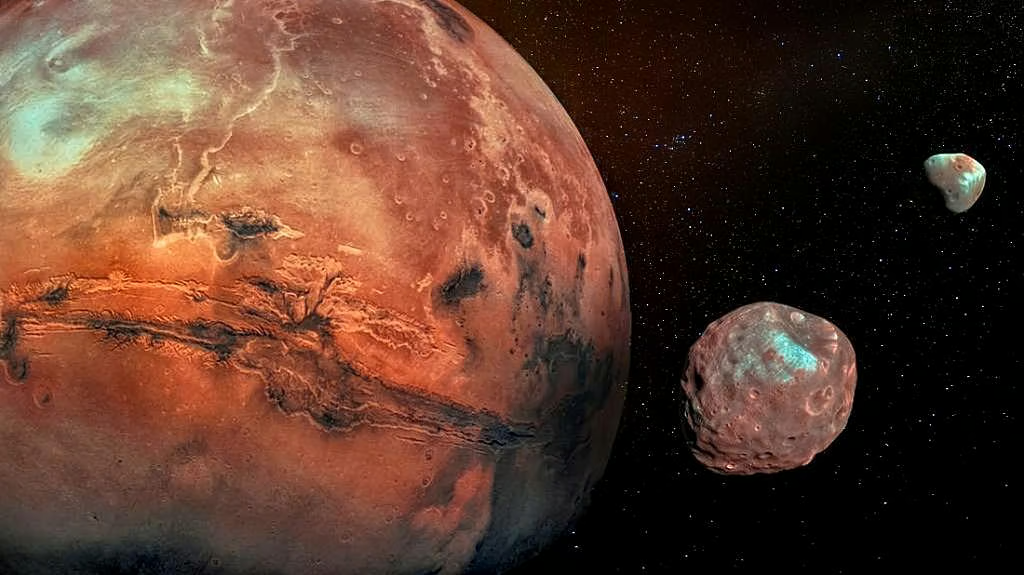
The Eclipse of Home: Perseverance Captures Earth’s Silent Passage Behind Phobos
In the quiet, rusted theater of Jezero Crater, a solitary, nuclear-powered sentinel keeps its vigil. On July 2, 2026—marking Sol 1,907 of its tireless tenure—NASA’s Perseverance rover performed an act as deeply human as it was mechanically precise: it paused its search for ancient Martian microbes, looked upward into the cold obsidian sky, and watched our home world vanish. In a newly released composite of seven exposures captured by the rover’s high-definition Mastcam-Z instrument, Earth is rendered not as the vibrant blue marble of our collective imagination, but as a fragile, brilliant bead of light, slipping quietly behind the jagged silhouette of Mars’s inner moon, Phobos.
***
> "It is a portrait of profound isolation, where our entire world is reduced to a transient footnote, momentarily swallowed by a celestial body that is itself little more than a lump of captured space debris."
***
The composition is an exquisite study in cosmic irony and scale. Phobos, a heavily cratered, potato-shaped rock destined to eventually shred itself into a ring under the pull of Martian gravity, looms dark and imposing in the foreground. Behind it, Earth drifts along its orbital track, carrying the sum total of human history, triumph, and tribulation within a few glowing pixels. The stark, absolute blackness enveloping the scene is a deliberate artifact of the observation; Perseverance utilized specialized solar filters designed to mitigate the sun’s blinding glare, rendering the surrounding cosmos in a stark, minimalist negative space that emphasizes the sheer vulnerability of our existence.
There is a sharp, melancholic elegance in the reality that humanity must send its robotic emissaries millions of miles into the void simply to capture the perspective we so desperately lack on the ground. The Mastcam-Z, engineered to dissect the mineral composition of alien riverbeds, here performs a far more existential service. It acts as a mirror, refracting our global dramas through the sobering lens of deep space. In an era defined by terrestrial noise and division, this silent, seven-frame choreography offers a masterclass in quietude—a reminder that everything we have ever built, loved, or fought over can be temporarily erased by a passing stone barely fourteen miles wide.