NASA’s MAVEN Mission Uncovers Shared Origin Behind Earth and Mars Auroras
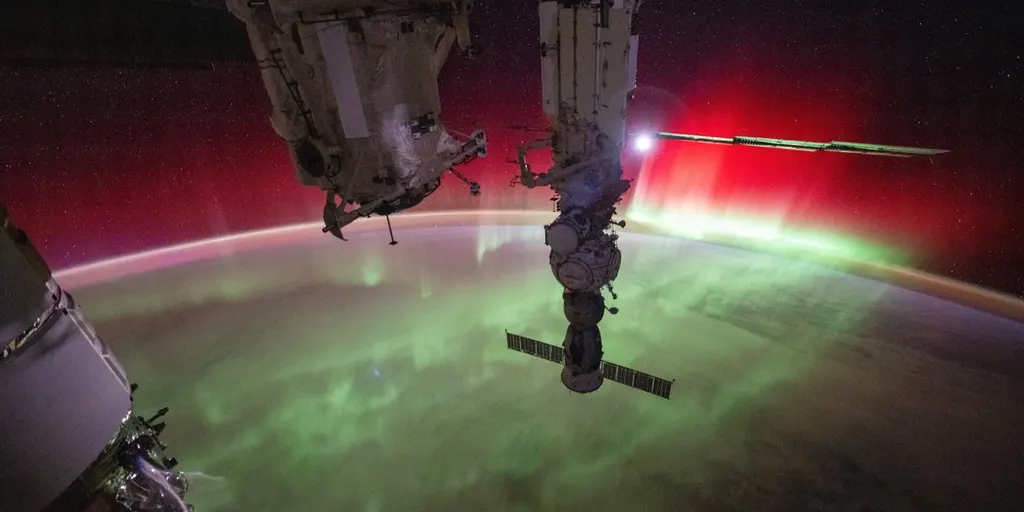
Scientists operating NASA’s Mars Atmosphere and Volatile Evolution (MAVEN) spacecraft have resolved a long-standing planetary mystery, discovering that certain types of Martian auroras share a common physical origin with the Northern and Southern Lights on Earth. According to a study published on Thursday in the journal Nature Communications, the same fundamental plasma physics mechanism that circulates and catapults charged particles into Earth’s upper atmosphere is also driving auroral displays on the Red Planet. This finding bridges a critical gap in our understanding of how solar wind interacts with planetary atmospheres across vastly different magnetic environments.
Unlike Earth, which is shielded by a robust, global magnetic field generated by its active core, Mars lost its global magnetosphere billions of years ago. Today, the Red Planet possesses only localized, patchy "crustal" magnetic fields pocketed primarily in its southern hemisphere. Because of these stark differences, scientists previously assumed that auroral phenomena on Mars operated under entirely different principles. However, the new MAVEN data reveals that despite the lack of a global magnetic envelope, the interaction between the solar wind and Mars' localized magnetic pockets triggers a highly efficient reconnection and acceleration process, channeling energetic electrons down into the Martian atmosphere to spark glowing auroral displays.
Key Takeaways from the MAVEN Discovery
- Universal Physics: The same magnetospheric processes that govern Earth's space weather are active at Mars, despite the Red Planet's lack of a global magnetic field.
- Atmospheric Escape: Understanding these auroral mechanisms helps scientists track how energy is transferred into the Martian atmosphere, fueling the escape of gases into space.
- Data-Driven Insights: The discovery relies on years of high-resolution plasma and magnetic field data gathered by MAVEN’s suite of scientific instruments.
"This discovery shows that the planetary mechanics governing auroras are remarkably universal," said a representative from the research team. "Whether a planet has a strong global magnetic shield like Earth, or weak, localized crustal fields like Mars, the fundamental physics of particle acceleration remains consistent. This challenges our previous assumptions about how unmagnetized or weakly magnetized planets interact with the solar wind."
Since entering orbit around Mars in September 2014, MAVEN has been analyzing the planet's upper atmosphere to determine how Mars transitioned from a warm, wet world that could have supported life to the cold, dry desert it is today. By illuminating these dynamic atmospheric interactions, the MAVEN mission continues to reshape how astrophysicists model planetary evolution. These insights are expected to refine future models of Mars' atmospheric loss and assist in preparations for future human exploration, where understanding localized space weather and radiation environments will be crucial for astronaut safety.