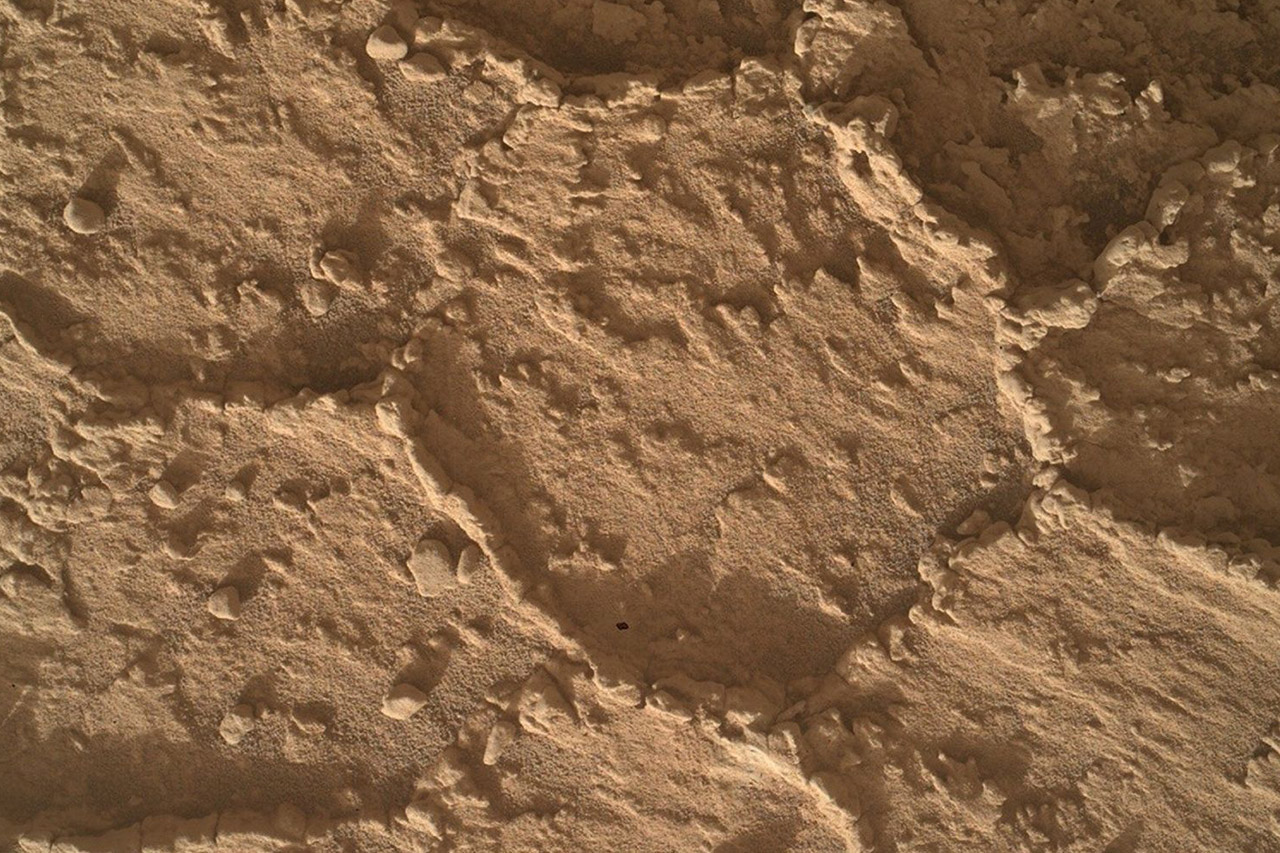
The Geometry of Desolation: Curiosity’s Silent Revelation on the Martian Clay
On the high, wind-scoured plains of Gale Crater, humanity’s oldest active robotic proxy on the Red Planet paused to look backward. It was June 2026—Sols 4,930 and 4,931 of a mission that has long since transcended its original operational brief—and the Curiosity rover was busy translating the silence of Mars into a spectacular, 360-degree mosaic. What its mast cameras captured was not merely another stretch of monotonous red basalt, but a vast, undulating tapestry of interlocking geometric polygons stretching toward the hazy horizon. While the rover has encountered these fractured formations before, it has never found them in such breathtaking, concentrated abundance. The scene suggests a sprawling, fossilized mosaic, a planetary confession written in the precise, elegant language of geometry.
To the untrained eye, these polygons resemble the cracked, parched earth of a terrestrial desert basin after a summer drought. To the planetary geologist, however, they are the lithic signatures of a deep and evocative history. These structures are the physical remnants of ancient, repeating wet-and-dry cycles—seasons of abundance followed by epochs of evaporation. As water saturated the Martian clay and subsequently vanished into the thin atmosphere, the swelling and shrinking mud fractured along predictable stress lines, leaving behind a geometric grid. To discover such an immense, uninterrupted field of them is to stand in the dried footprint of an ancient lakebed that once hummed with the thermodynamic potential for life.
```
"The polygons are more than geological curiosities; they are the physical remnants of ancient, repeating wet-and-dry cycles."
```
There is a quiet, poetic irony in Curiosity’s continued success. Operating far past its expected lifespan, the plutonium-hearted machine has become a monument to human persistence, documenting a world characterized by its own ancient permanence. As the rover edges closer to its 5,000th sol on Mars, discoveries like this polygon field remind us that the Red Planet was not always a static, frozen desert. It was once a world of ebb and flow, of seasonal rhythm, and of chemical transitions—a dynamic cradle where the building blocks of life may have once found a brief, structured home in the mud.