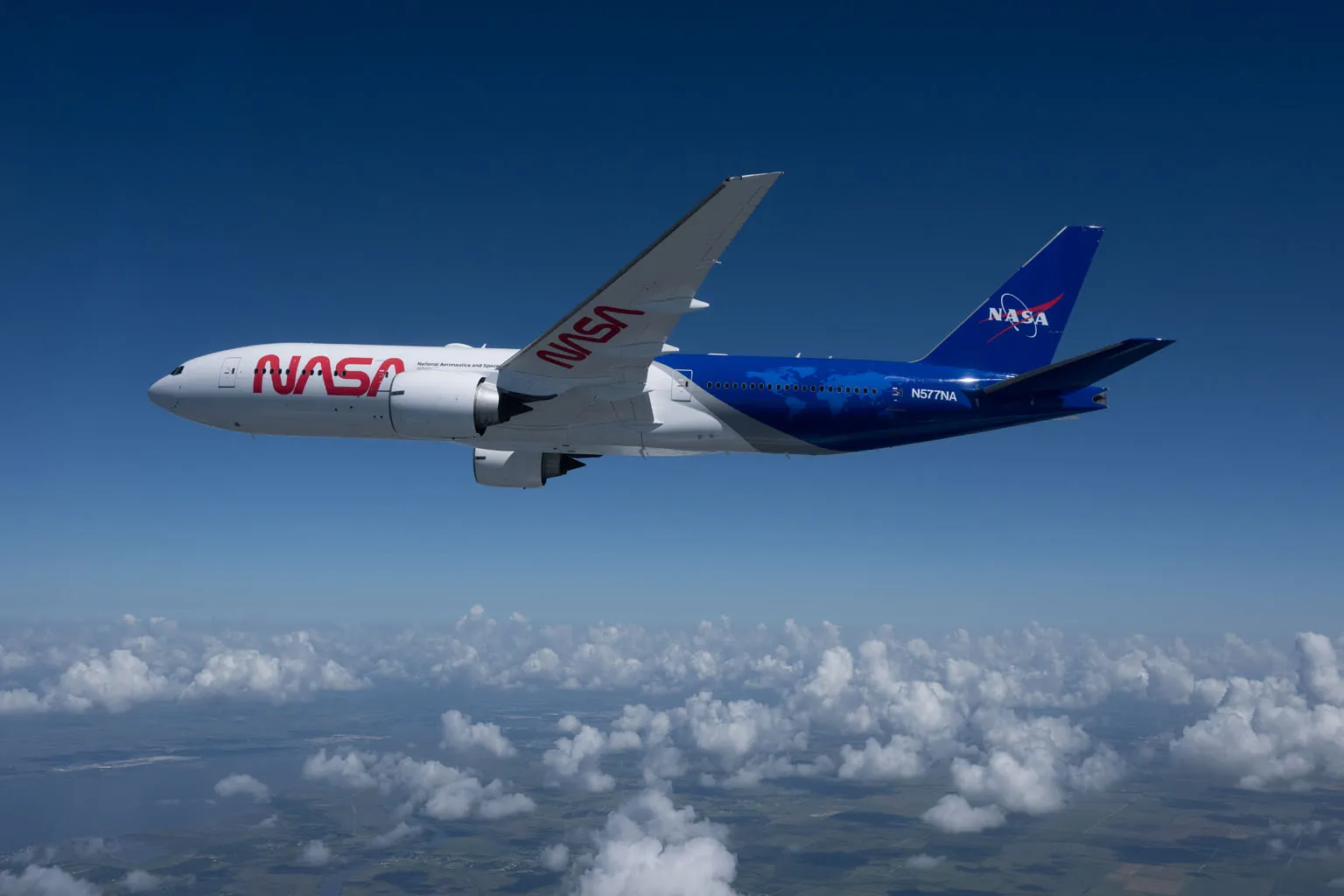
The Art of the Ascent: NASA’s New Boeing 777 Sheds Its Commercial Skin
In the sterile, cavernous hangars where state science meets the sky, there is a distinct poetry to a fresh coat of paint. On August 11, 2026, NASA unveiled the immaculate new livery of its newly acquired Boeing 777—a gleaming expanse of crisp white and iconic blue that signals far more than mere aesthetic upkeep. This twin-engine titan, salvaged from the monotonous transcontinental cycles of commercial passenger service, has been christened as the rightful heir to the legendary Douglas DC-8, the beloved airborne laboratory that was retired in 2024 after more than a half-century of pioneering atmospheric research. Where the DC-8 possessed the rugged, analog charm of mid-century engineering, the incoming 777 represents a sleek, digital leap forward: a state-of-the-art vessel ready to be etched with the complex telemetry of a changing planet.
A Stratospheric Metamorphosis
Set to begin operations in 2027 from NASA’s historic Langley Research Center in Hampton, Virginia, the reconfigured widebody will serve as a peerless suborbital observatory. To prepare such a colossal aircraft for the delicate nuances of Earth science is an exercise in meticulous engineering alchemy. The pristine exterior paint is the final, outward manifestation of an intense internal metamorphosis. Stripped of its rows of passenger seats, galleys, and overhead bins, the cabin is being transformed into a sophisticated labyrinth of custom instrument racks, researcher consoles, and specialized atmospheric sampling ports. When it takes to the air, this flying laboratory will carry advanced lidars, spectrometers, and air-sampling probes, allowing scientists to dissect the atmosphere with unprecedented precision.
The Geography of Tomorrow
There is a quiet, poetic irony in repurposing an aircraft designed for global commerce—carrying passengers across oceans to fuel global markets—into a sentinel tasked with measuring the ecological toll of that very connectivity. As it sits on the tarmac in Virginia, pristine and expectant, the 777 embodies a bridge between two eras of aviation and scientific discovery. It represents a renewal of NASA’s commitment to airborne science at a historical juncture when understanding atmospheric dynamics, greenhouse gas concentrations, and air quality is no longer just an academic pursuit, but an existential imperative. When its massive turbofans finally spool up for its inaugural scientific mission in 2027, this transformed giant will not merely be chasing horizons; it will be mapping the fragile boundaries of our collective future.