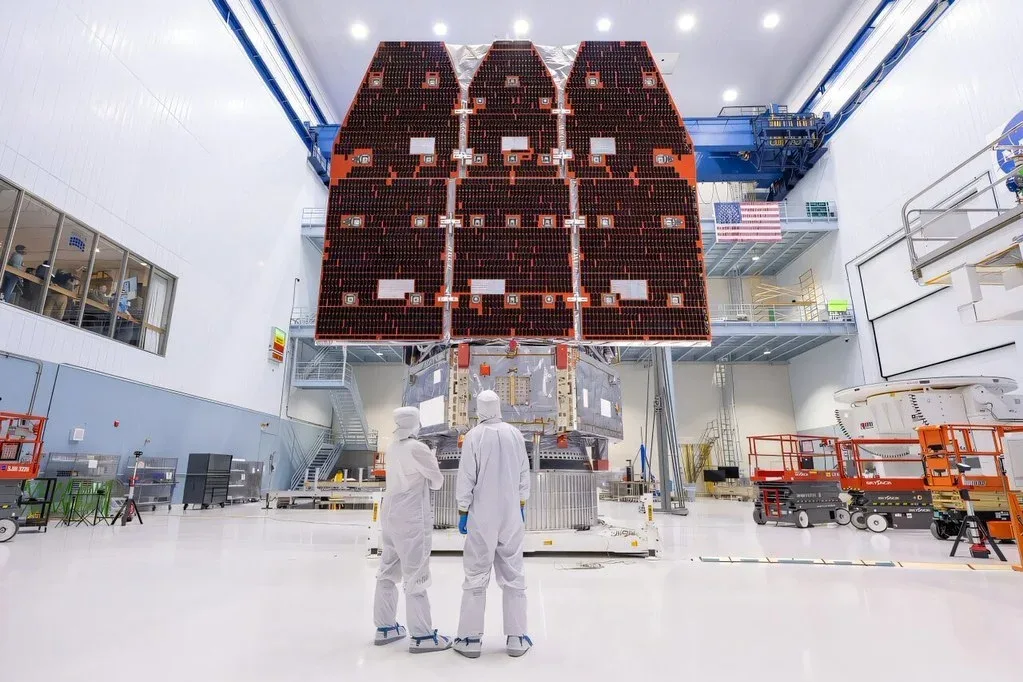
The Wide-Angle Cosmos: NASA Prepares the Nancy Grace Roman Space Telescope for Ascent
In the pale, salt-rimed light of a Florida late-summer morning, humanity will once again attempt to throw a glass eye into the dark. NASA has finalized its broadcast choreography for the launch of the Nancy Grace Roman Space Telescope, an instrument engineered not merely to look at the cosmos, but to peer into its deepest, most stubborn silences. Scheduled to ascend no earlier than 7:26 a.m. EDT on Sunday, August 30, atop the muscular, triple-core columns of a SpaceX Falcon Heavy rocket, Roman represents a profound technological shift. It is a machine born of a restless impatience with our current cosmological maps—an observatory designed to trade the deep-well, pinpoint scrutiny of its predecessors for a panoramic, cinematic sweep of the heavens.
Named in honor of Nancy Grace Roman, the pioneering astronomer affectionately remembered as the “Mother of Hubble,” the telescope carries a mandate that is as much philosophical as it is empirical. While the James Webb Space Telescope operates like an exquisite cosmic microscope, dissecting the infancy of individual galaxies, Roman is built to act as a vast, wide-angle lens. Equipped with a 300-megapixel infrared camera, its field of view is a staggering one hundred times greater than that of Hubble. The primary quarry of this multi-billion-dollar voyage is the invisible scaffolding of the universe itself: dark energy, the mysterious force accelerating the cosmos' expansion, and the shadow-play of dark matter.
> "We are searching for the invisible signatures that dictate the fate of the universe—measuring the gravitational fingerprints left on billions of distant galaxies."
The choice of the Falcon Heavy as its chariot underscores the current era of spaceflight—a marriage of NASA’s legacy of rigorous, state-funded exploration and SpaceX’s industrial, commercial pragmatism. As the boosters ignite over the Atlantic, they will carry not just a payload of mirrors and microchips, but the collective anxiety of an astronomical community starved for definitive answers to the universe's ultimate expansion rate. NASA’s planned prelaunch and launch coverage promises to translate this high-stakes engineering drama into a shared global liturgy. In an age increasingly defined by terrestrial myopia, the Roman Space Telescope stands as a rare, elegant monument to our capacity for collective curiosity, a reminder that we are at our most human when we are looking up, demanding that the darkness surrender its secrets.