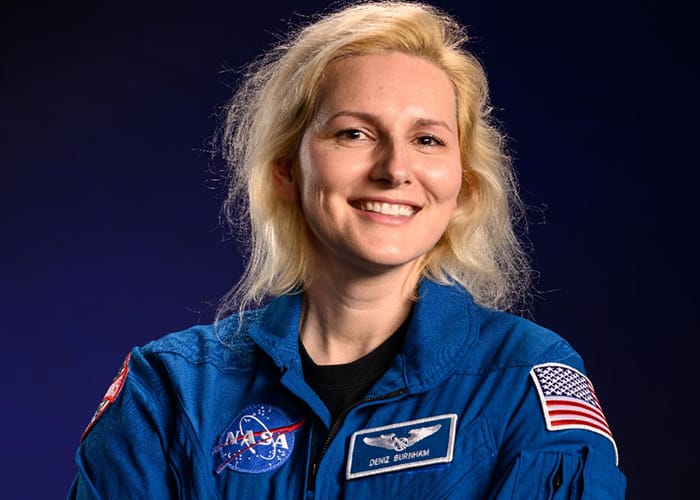
The Quiet Gravity of the Steppes: Deniz Burnham’s Ascent to the Orbital Outpost
There is a peculiar, almost monastic solitude to the Baikonur Cosmodrome—a sweeping expanse of Kazakh steppe where the ghosts of the Space Age whisper against the modern machinery of human ambition. It is from this historic, wind-scoured cradle that NASA astronaut Deniz Burnham will begin her journey into the sky in March 2027. Assigned as a flight engineer for Expedition 76, Burnham is slated to launch aboard the Roscosmos Soyuz MS-30 spacecraft, a mission that represents both her maiden voyage into orbit and the continuation of a fragile, decades-long international dance. Accompanying her into the thermosphere are Russian cosmonauts Dmitri Petelin and Konstantin Borisov, a trio whose shared capsule will serve as a claustrophobic bridge between terrestrial borders and the borderless vacuum of space.
```
"To touch the edge of the atmosphere is to trade the comfortable fiction of gravity for the absolute truth of the void."
```
Burnham’s trajectory to the stars is defined by a distinct, rugged pragmatism—a quality cultivated far from the sterile cleanrooms of Houston. Before her selection to the astronaut corps, she carved out a career in the demanding, high-stakes world of offshore drilling, managing complex engineering operations in some of the earth's most unforgiving environments. This background in chthonic pressure and industrial isolation makes her an ideal custodian for the International Space Station, a vessel that is itself a pressurized sanctuary suspended in a lethal sea. For Burnham, the transition from boring deep into the earth to soaring high above it is not a contradiction, but a logical continuation of a life spent navigating extreme thresholds where the margin for error is measured in millimeters and heartbeats.
The geopolitics of the mission are impossible to ignore, yet they are quietly sublimated by the daily, tedious reality of survival in low-Earth orbit. In an era where terrestrial alliances are increasingly fractured, the joint crew of Soyuz MS-30 remains a stubborn monument to scientific co-dependence. As Burnham, Petelin, and Borisov prepare to spend their half-year tenure aboard the aging orbital laboratory, their work will transcend the immediate horizon of scientific experimentation. They will step into a legacy where the shared air of a space station is the ultimate equalizer, proving once more that in the silent dark of the cosmos, survival is a collaborative art form.