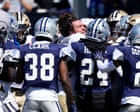
Blood, Sweat, and Dust in the California Sun: Inside the Saints-Cowboys Joint Practice Meltdown
In the dog days of August, NFL training camps cease to be mere laboratories of tactical refinement and instead morph into high-voltage theaters of existential anxiety. Under the relentless glare of the Southern California sun, where the New Orleans Saints and Dallas Cowboys convened for a joint practice session, the thin veneer of professional collegiality quickly dissolved into tribal warfare. What was designed as a controlled crucible of preparation deteriorated into a series of ugly, chaotic skirmishes—at least six separate brawls—that laid bare the frayed nerves and boiling testosterone of men fighting not just for yards, but for their roster spots.
The escalation was both sudden and predictable. In a landscape where violence is systematically commodified, the boundary between sanctioned aggression and raw hostility is notoriously porous. The afternoon’s most combustible moment belonged to Donovan Ezeiruaku, whose decision to throw punches resulted in a swift ejection, a momentary rupture in the choreographed dance of the gridiron. Yet, the day's most sobering tableau belonged to Saints wide receiver Ronnie Bell. Having immersed himself in the thick of the midday melee, Bell found himself vanquished not by an opposing cornerback, but by the oppressive, shimmering atmosphere. Visibly spent and reeling from the combined toll of physical combat and thermal exhaustion, he was ultimately carted off the field—a stark, fragile image of human limitation amid a spectacle of performative toughness.
In the aftermath, the coaching brass attempted to sanitize the chaos with the flat, uninflected language of athletic bureaucracy.
> "He just had to go inside for a little bit. He just got a little bit overheated,"
remarked New Orleans coach Kellen Moore, offering a clinical, almost dismissive assessment of Bell’s collapse that contrasted sharply with the visceral drama of the preceding hours. This casual minimization is characteristic of an industry that views the human body as an exchangeable part in a larger machine. Joint practices, long sold to public relations departments as elite workshops of collaborative excellence, have increasingly exposed themselves as volatile tinderboxes. When the whistle blows in August, the line between preparation and self-destruction is as thin as the chalk on the sideline, leaving franchises to sweep away the debris of an afternoon where football took a back seat to fury.