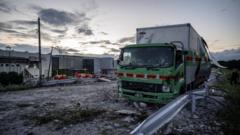
The Shuddering Earth: In Japan, a Hundred Tremors and the Agony of Suspense
As aftershocks rattle a grieving nation, the psychological toll of seismic precarity rivals the physical ruin.
In the quiet intervals of a Japanese afternoon, the earth does not merely shake; it rewrites the terms of human survival. The recent, devastating earthquake that claimed at least thirteen lives was not a singular cataclysm, but a violent opening movement. In the immediate wake of the disaster, the physical toll has revealed itself in the classic, heartbreaking iconography of Japanese seismic tragedy: the splintered remains of traditional tiled roofs collapsed under their own weight, and the sudden, jagged chasms cutting through pristine asphalt. Yet, the true scale of the catastrophe is measured not just in fractured concrete, but in the sudden, silent void left by those thirteen lives cut short—a stark reminder that for all of Japan’s unmatched engineering prowess, humanity remains a tenant on sufferance upon an indifferent crust.
The ordeal, however, refuses to offer the clean closure of a post-disaster cleanup. In the hours following the initial rupture, the earth has shuddered more than a hundred times, a relentless sequence of aftershocks that keeps the affected regions suspended in a state of exhausting, hyper-vigilant anxiety. Meteorological officials have issued urgent warnings that the worst may not be over, cautioning that subsequent tremors could reach a catastrophic magnitude of 7. This psychological siege—the waiting for the other shoe to drop, the sudden adrenaline spike at the rattling of a teacup—transforms the act of survival into a grueling war of attrition. It is a purgatorial state where the ground beneath one's feet, the very archetype of permanence, becomes an active adversary.
> "The psychological siege—the waiting for the other shoe to drop—transforms the act of survival into a grueling war of attrition."
There is a profound, stoic elegance to how Japan confronts these violent reminders of its own precarity. This is a nation forged in the crucible of fault lines, its cultural consciousness deeply attuned to the transience of existence. Yet, this philosophical resilience is currently being tested to its absolute limit. Rescue teams must navigate unstable debris fields under the constant, demoralizing threat of further collapse, their efforts a race against both the weather and the ticking clock of tectonic instability. The warnings of impending magnitude 7 shocks are not merely bureaucratic advisories; they are a grim choreography of survival, urging a weary populace to remain poised on the knife-edge of flight. In the cold light of the disaster zone, the struggle is no longer just about excavating what was lost, but bracing against the violence of what might still come.