The Scar in the Soil: A Stray Missile and the Fragile Frontiers of Europe
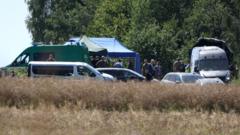
The quietude of the Polish countryside has long served as a silent buffer to the convulsions of history, but near the village of Tarnawa Kolonia, that illusion of pastoral immunity was violently shattered. A ten-meter-wide crater now punctures the earth, a raw, muddy wound sliced into the landscape a full one hundred kilometers from the Ukrainian border. This is no longer merely a localized mishap; it is a physical manifestation of the existential vertigo currently gripping Eastern Europe. For months, the war had been something watched on screens or felt through the economic tremors of inflation and refugee integration. Now, the soil itself has registered the impact, bringing the kinetic reality of the Kremlin’s campaign directly into the sovereign territory of a NATO member state.
In Warsaw, the political reaction was marked by a tense, calibrated gravity. The Polish Prime Minister delivered a grim assessment, declaring that the missile which hollowed out the earth near Tarnawa Kolonia was "probably Russian." In the lexicon of modern diplomacy, the word probably carries an agonizing weight—it is a rhetorical brake applied to prevent immediate escalation, even as it points an accusing finger at Moscow. For a nation that has spent the last century navigating the perilous geography of being positioned between Western ambitions and Russian imperial revanchism, the crater is a chilling reminder that borders are only as secure as the restraint of those who seek to redraw them.
> "We are operating under the assumption of maximum vigilance," a senior diplomatic source remarked off the record. "When a weapon of this caliber penetrates one hundred kilometers into our territory, the luxury of treating it as a mere anomaly evaporates."
For the residents of Tarnawa Kolonia, geopolitics has abruptly ceased to be an intellectual abstraction debated in the corridors of Brussels or Warsaw. The thirty-three-foot crater is a monument to a new, precarious normal, where the margin for error in the skies over Ukraine can yield terrifying consequences on the ground in Poland. This incident exposes the fraying edges of European security, proving that the containment of modern conflict is a fantasy. As investigators sift through the charred debris in the Polish fields, the continent is left to contemplate a unsettling truth: the war is no longer contained behind a border, and the ground beneath Europe’s feet is shifting in more ways than one.