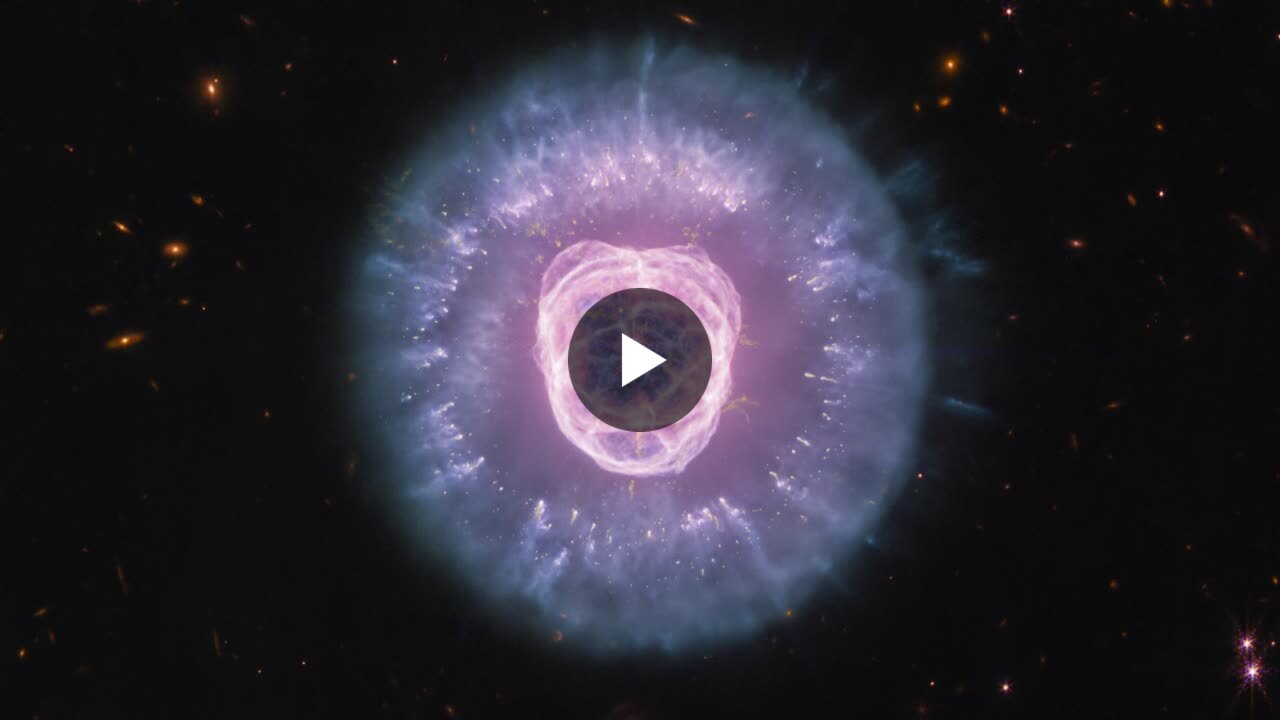
The Celestial Beast Reborn: Webb’s Infrared Eye Rewrites the Legend of the Lion Nebula
In the silvered silence of the cosmos, humanity has long sought to map its own terrestrial myths onto the stars. We project our wilderness onto the void, searching for faces, beasts, and familiar geometries in the cold dust of deep space. For over two decades, NGC 2392—popularly known as the Lion Nebula—served as one of the cosmos's most evocative portraits. Imaged by the Hubble Space Telescope in the halcyon days of 2000, this planetary nebula captured the public imagination with its striking resemblance to a majestic feline face, framed by a halo of comet-like structures that resembled a wild, glowing mane. But Hubble’s vision, glorious as it was, was bound to the visible spectrum—a brilliant, surface-level rendering of a much more complex cosmic dissolution.
Now, NASA’s James Webb Space Telescope has turned its highly sensitive infrared gaze toward this iconic stellar tomb, stripping away the dust to reveal the intricate physics of a dying star. Where Hubble saw a static visage, Webb detects a roiling, thermodynamic theater. Planetary nebulae are, of course, cosmic misnomers—they have nothing to do with planets, but are instead the elegant, violent obituaries of stars similar to our Sun. As the central star sheds its outer envelopes of gas, it carves out a hollowed-out shell of dust. Webb’s Near-Infrared Camera (NIRCam) and Mid-Infrared Instrument (MIRI) pierce through this shroud, transforming what once looked like a fuzzy "mane" of gas into a highly defined web of supersonic wind collisions and thermal emissions.
> "Webb’s infrared vision does not merely photograph the celestial beast; it dissects its metabolism, revealing the intricate mechanics of stellar death."
This technological leap from the imagery of 2000 to the present day represents more than a triumph of engineering; it reflects a profound evolution in how we conceptualize the universe. The comet-shaped objects making up the Lion’s mane are no longer mere aesthetic curiosities. Under Webb’s scrutiny, they are revealed as dense knots of molecular gas, shielded from the central star’s harsh ultraviolet radiation but buffeted by its relentless stellar wind. This interaction creates a dynamic, flowing boundary layer that is constantly reshaping the nebula. By capturing the warm glow of dust grains and the specific signatures of hydrogen molecules, Webb provides astrophysicists with a pristine laboratory for studying how elements are redistributed back into the interstellar medium—the very material that will one day coalesce into new generations of stars and planets.
Ultimately, the new imagery of NGC 2392 serves as a poignant memento mori. In the delicate, glowing structures of the Lion Nebula, we are looking at a mirror of our own solar system's distant future. Some five billion years from now, our own Sun will exhaust its nuclear fuel, swell into a red giant, and puff its outer layers into the dark in a similarly breathtaking display of cosmic artistry. By decoding the roaring silence of the Lion Nebula, Webb does not just illuminate a distant curiosity; it writes the final, elegant chapter of our own cosmic history.