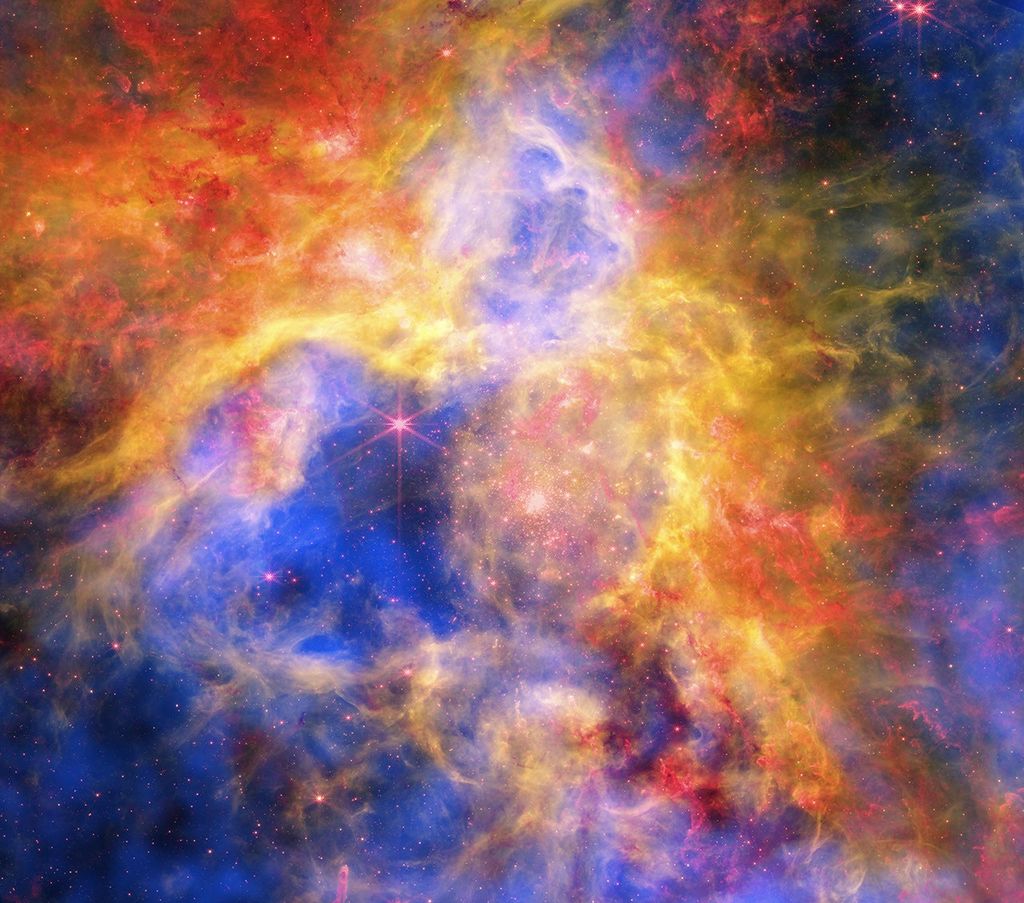
The Celestial Beast Unbound: Webb’s Infrared Eye Captures the Silent Roar of the Lion Nebula
In the silent, indifferent theater of the cosmos, humanity has long sought to project its own terrestrial mythologies onto the canvas of the infinite. On August 10, 2026, the James Webb Space Telescope—our premier instrument of cosmic voyeurism—turned its golden, hexagonal eye toward the constellation Gemini, delivering a breathtakingly sharp portrait of NGC 2392, colloquially known as the Lion Nebula. Where previous observatories saw only a faint, blurred ghost of a dying star, Webb has revealed a structure of feral majesty. The image does not merely capture a cosmic object; it documents a violent, slow-motion exhalation of stellar gas, rendered with the crisp precision of a Renaissance master’s etching.
At the heart of this newly released image lies the nebula’s signature "mane," a complex, billowing shroud of gas and dust that seems to ripple outward into the interstellar void. What Webb’s near- and mid-infrared instruments have captured is the exquisite debris of a dying, sun-like star shedding its outer layers in a series of titanic convulsions. The high-resolution data reveals intricate, radial filaments—the "strands" of the mane—sculpted by fierce stellar winds and intense radiation. This is not static beauty, but a thermodynamic battlefield. The sheer resolution of the August 2026 data allows astrophysicists to trace the delicate boundaries where hot, ionized gas collides with the colder, darker envelope of the outer cosmos, transforming a standard astronomical catalog entry into a vivid study of celestial decay.
The moniker of the "Lion" is more than a convenient shorthand; it reflects a deep-seated human impulse to find order and ferocity in the cold mechanics of astrophysics. Yet, the true power of Webb's latest dispatch lies in how it dismantles our expectations of the cosmic wilderness. By translating the invisible wavelengths of infrared light into a palette of brilliant copper, deep indigo, and electric gold, the telescope provides a visual syntax for things we were never meant to see. This is the triumph of modern observational astronomy: it strips away the veil of dust to expose the raw, kinetic anatomy of the universe, proving that the reality of stellar death is far more baroque and haunting than any mythological beast we could conjure.
Ultimately, this portrait of NGC 2392 serves as a poignant memento mori on a galactic scale. The dying star at the center of the Lion’s mane foretells the eventual fate of our own Sun, some five billion years hence. To gaze upon the Lion Nebula is to look into a mirror of our solar system's distant future, a realization that lends Webb's hyper-detailed imagery an almost existential weight. As the telescope continues its silent vigil across the deep plains of space, it does not just catalog the heavens; it writes the biography of matter itself, reminding us that we are merely fleeting observers of a grand, luminescent dissolution.