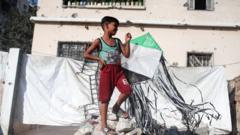
In the sun-bleached borderlands where the dense concrete of the Gaza Strip meets the manicured agricultural kibbutzim of southern Israel, the sky has lately become a theater of surreal, slow-motion hostility. Against the backdrop of high-tech surveillance towers and iron-clad security fences, a fleet of makeshift kites—fashioned from plastic, scrap wood, and twine—has been drifting across the divide. To watch them hover on the Mediterranean breeze is to witness a strange collision of pastoral innocence and low-intensity warfare. Yet these fragile vessels, often carrying burning rags or embers, have ignited a volatile diplomatic standoff, prompting Israel to warn of a "forceful" military retaliation against what it views as a highly coordinated campaign of ecological and psychological terror.
To the Israeli defense establishment, these airborne anomalies are not mere manifestations of juvenile mischief, but a cynical, asymmetric strategy designed to bypass sophisticated defense systems like the Iron Dome. In recent days, these primitive incendiary devices have scorched hundreds of acres of Israeli wheat fields and nature reserves, transforming dry farmland into charred, smoking expanses. The Israeli military’s promise of a muscular response underscores a deeper, systemic anxiety: the realization that a modern, highly digitized army can be effectively harassed, and its civilian population unnerved, by tools that cost less than a loaf of bread. For a nation whose security doctrine is built on absolute deterrence, the drift of a paper kite represents an intolerable breach of sovereignty.
> "We cannot allow the skies of our border communities to become a launching pad for arson under the guise of child's play."
Hamas, the governing authority in the blockaded enclave, has swiftly cloaked the phenomenon in the powerful optics of victimhood and youth. According to officials in Gaza, the kites are not tactical weapons, but spontaneous expressions of frustration launched by children seeking a literal and symbolic escape from their landlocked reality. By framing the kites as the handiwork of Gaza’s youth, Hamas exploits a cruel but effective asymmetry, daring Israel to deploy its state-of-the-art military apparatus against toys. It is a masterclass in the grim semiotics of modern conflict: the kite, history’s most benign emblem of childhood flight, is conscripted into a geopolitical chess game where innocence is both a shield and a weapon.
Ultimately, this airborne skirmish reveals the tragic, claustrophobic deadlock that defines the region. As Israel prepares a "forceful" campaign to ground the kites—potentially targeting the infrastructure of those who manufacture and launch them—the cycle of escalation threatens to turn a symbolic provocation into a bloody confrontation. In this bitter stretch of the Levant, even the wind cannot cross the border without being conscripted into the war, leaving both sides trapped in a landscape where even the sky offers no sanctuary from the gravity of history.