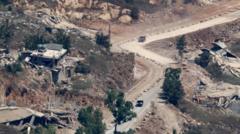
Israel Conducts Airstrikes in Southern Lebanon Amid Hezbollah Backlash Over New Framework Agreement
A series of Israeli airstrikes struck southern Lebanon on Friday, killing at least one person and wounding several others, according to Lebanese state media. The military escalation comes less than 24 hours after Lebanese and Israeli officials signed a highly anticipated framework agreement aimed at stabilizing their volatile border. The fragile diplomatic breakthrough was immediately overshadowed by violence on the ground and fierce political opposition from Hezbollah, the powerful Iranian-backed militant group and political party, which formally condemned the deal.
The framework agreement, brokered after months of intense international mediation, was intended to establish a roadmap for resolving long-standing boundary disputes between the two nations, which remain technically at war. However, Hezbollah’s leadership quickly denounced the accord, warning that it paves the way for normalization with Israel. In a statement, a senior Hezbollah representative declared the agreement "null and void," asserting that the group would continue to resist Israeli presence along the UN-demarcated Blue Line. Analysts suggest the group's sharp rhetoric is aimed at maintaining its domestic position as the primary defender of Lebanese sovereignty.
According to the National News Agency (NNA), the state-run Lebanese outlet, the Israeli strike targeted an area near the southern border town of Khiam, resulting in at least one fatality. The Israel Defense Forces (IDF) did not immediately comment on the specific casualty but issued a statement confirming that its air force had targeted "military infrastructure" in southern Lebanon. The IDF maintained that the operations were a necessary response to intelligence indicating imminent threats along the border. Local residents reported hearing heavy explosions, raising fears of a broader return to protracted cross-border conflict.
Key Obstacles to Regional Stability
- Diplomatic Fragility: The framework agreement lacks robust enforcement mechanisms, leaving it vulnerable to immediate sabotage by non-state actors.
- Hezbollah's Veto Power: As a major political and military force in Lebanon, Hezbollah retains the capability to unilaterally disrupt state-level diplomatic initiatives.
- Economic Stakes: The border disputes are closely tied to potential offshore natural gas reserves, which cash-strapped Lebanon desperately hopes to exploit to ease its severe economic crisis.
The sudden flare-up underscores the extreme volatility of the Israel-Lebanon border and the severe challenges facing any diplomatic resolution. While international mediators had hoped the framework agreement would unlock foreign investment and stabilize the southern region, the combination of direct military action and Hezbollah's outright rejection highlights the deep internal divisions within Lebanon, threatening to derail the peace process before its implementation can begin.