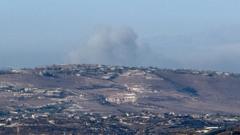
The Phantom Truce: Renewed Airstrikes Shatter the Fragile Quiet of Southern Lebanon
In the bruised landscapes of southern Lebanon, peace has long been less a durable state of being than a nervous pause between breaths. This week, that delicate silence was abruptly punctured not merely by the roar of Israeli jets, but by the cold, administrative certainty of an evacuation warning—the first of its kind to be issued in weeks. For the thousands of displaced residents who had begun to contemplate the bitter-sweet prospect of homecoming, the sudden digital decrees from the Israel Defense Forces (IDF) served as a grim reminder of how quickly diplomatic ink evaporates under the heat of borderland reality. Within hours of the warnings, the sky over the south contorted once more with gray plumes, as Israeli airstrikes hit what they characterized as hostile targets, leaving at least one person dead according to the Lebanese Health Ministry, and violently resetting the clock on a precarious regional stability.
The military calculus behind this sudden rupture was presented with the clinical detachment typical of modern warfare. Jerusalem asserted that the strikes were not an act of unilateral aggression, but rather a necessary, defensive calibration—a direct response to what the IDF characterized as ongoing ceasefire violations by Hezbollah. In this theater of armed choreography, the terms of engagement are constantly litigated in real-time, with both factions claiming the mantle of righteous retaliation. Yet, the distinction between a preemptive correction and a retaliatory gesture becomes entirely academic when measured against the fresh debris. The single casualty reported in the wake of the strikes stands as a tragic punctuation mark to an agreement that was supposed to silence the guns, exposing instead the profound fragility of a truce built upon the shifting sands of mutual distrust.
> "To flee is to abandon the remnants of life to the caprice of airstrikes; to stay is to risk becoming collateral damage in a conflict that views entire neighborhoods as mere coordinates."
Underneath the high-level geopolitical posturing lies a deeper, more intimate psychological warfare. The evacuation warning, delivered via social media maps and algorithmic alerts, has evolved into a macabre ritual of modern displacement. It forces civilians into an agonizing, instantaneous lottery: to flee is to abandon the remnants of their lives to the caprice of airstrikes; to stay is to risk becoming collateral damage in a conflict that views their neighborhoods as mere strategic coordinates. This latest spasm of violence suggests that the diplomatic frameworks brokered in distant, air-conditioned capitals remain fundamentally disconnected from the volatile reality on the ground. As smoke billows once more over the historic hillsides of the south, the promise of a lasting peace looks less like a tangible future and more like a cruel, recurring mirage.